 Sharen C Soucie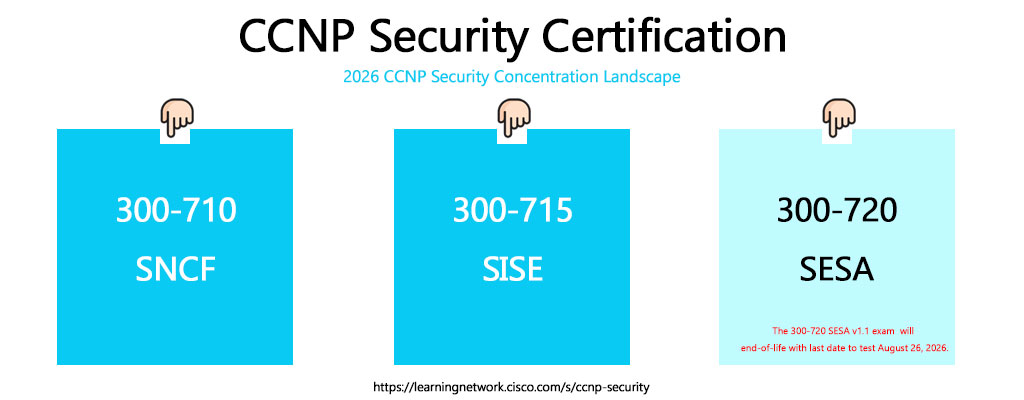
Most engineers think choosing a CCNP Security concentration is just about passing an exam. It’s not—it’s a directional bet on where your career is going.
With 300-720 SESA officially retiring on August 26, 2026 and blueprint updates rolling out across SNCF and SISE, this decision just became more constrained—and more strategic.
What changed recently isn’t just exam availability. Cisco quietly shifted weight toward identity, Zero Trust, and operational security, which means your concentration choice now signals your relevance in modern environments—not just your certification status.
🛡️ Quick Comparison Table
| Exam | Core Focus | Real-World Use Case | 2026 Considerations |
|---|---|---|---|
| 300-710 SNCF | Firewalls (FTD, FMC, IPS) | Perimeter security, segmentation, traffic control | Updated v1.2, still highly relevant |
| 300-715 SISE | Identity & Access Control (ISE) | NAC, Zero Trust, BYOD onboarding | Major update (v1.2), growing demand |
| 300-720 SESA | Email Security Gateway | Spam filtering, DLP, phishing protection | Retiring Aug 2026 |
📍 300-710 SNCF: When It’s the Right Choice
If more than half your day involves firewall rules, outages, or “why is traffic dropping,” then SNCF isn’t optional—it’s your reality.
In one of my recent deployments—about 12,000 endpoints across healthcare—we rolled out Cisco FTD in HA across multiple sites. What surprised me wasn’t the configuration complexity. It was how fragile the environment became under asymmetric routing and partial failover conditions.
Most engineers underestimate how messy real firewall deployments get once traffic patterns stop being predictable.
Here’s the catch: the exam tests concepts, but production punishes assumptions.
Where Engineers Get It Wrong
- They think knowing FMC UI = knowing firewall operations
- They ignore packet flow logic, especially prefilter vs ACP
- They don’t test failover behavior under real traffic
And that’s exactly where things break.
In practice, the hardest part isn’t writing rules—it’s debugging intermittent issues across zones, NAT, and IPS policies simultaneously.
Real Insight From the Field
When I coach engineers on 300-710 SNCF vs 300-715 SISE, I ask one question:
“Have you ever troubleshot dropped traffic at 2 AM under pressure?”
If yes, SNCF aligns with your daily work.
During my own prep, I used Leads4Pass occasionally—not as a shortcut, but to sanity-check configurations before lab validation. It helped me catch gaps between what I thought I understood and what the exam expected.
When SNCF Makes Sense
- You work in SOC / NOC / firewall operations
- Your team still relies heavily on perimeter-based security
- You troubleshoot traffic flow issues weekly
If your job revolves around controlling packets, SNCF is the most honest reflection of your role.
🔑 300-715 SISE: Identity Is the New Control Plane
Here’s what most engineers still don’t fully accept:
The network is no longer the control plane—identity is.
That shift is exactly why 300-715 SISE has become one of the most valuable CCNP Security concentration choices in 2026.
Cisco’s latest updates doubled down on this. The new SISE blueprint pushes deeper into:
- BYOD lifecycle
- Posture assessment
- Zero Trust alignment
But let me translate that into reality.
What It Looks Like in Production
In a financial environment I worked on, compliance required device posture checks before granting access. Sounds simple—until you deal with:
- Non-compliant endpoints
- Certificate failures
- Guest onboarding chaos
ISE becomes less about configuration and more about policy logic at scale.
And that’s where engineers struggle.
Where Engineers Underestimate Complexity
They think ISE is just “NAC with policies.” It’s not.
- You’re managing identity + device + context simultaneously
- You’re integrating with AD, MDM, PKI
- You’re debugging authentication chains, not packets
The difficulty shifts from technical commands to logical design.
Why SISE Is Future-Proof
Zero Trust isn’t a buzzword anymore—it’s an audit requirement.
In practice:
- Firewalls block traffic
- ISE decides who gets access in the first place
That’s a fundamentally higher layer of control.
When SISE Is the Right Choice
- You’re moving into architecture or design roles
- Your environment is compliance-heavy (finance, healthcare, gov)
- You deal with user/device onboarding and access policies
If you want to move away from firefighting and toward control-plane design, SISE is the smarter long-term bet.
📧 300-720 SESA: Niche Skill, Timing Risk
Let’s be direct: choosing SESA in 2026 is a timing gamble.
Yes, email security is still critical. In fact, phishing remains one of the top attack vectors in most enterprises. But the certification itself is on a countdown—retiring August 26, 2026.
The Reality Nobody Talks About
I’ve deployed Cisco ESA in multiple environments. It works. It’s powerful.
But here’s what changed:
- Many companies are moving to cloud email security (M365, Google Workspace)
- Secure Email Gateway is becoming less central
- Skill demand is flattening compared to identity and cloud security
When SESA Still Makes Sense
- You already manage Cisco Secure Email Gateway
- Your company hasn’t migrated to cloud-native email security
- You need a quick specialization before retirement
Otherwise, you’re investing in a shrinking niche.
⚖️ My Decision Framework
When engineers ask me how to make a CCNP Security concentration choice, I don’t give them options—I give them constraints.
1. What do you troubleshoot weekly?
Your daily pain is your best signal.
2. What does your environment prioritize?
Follow where your company spends money.
3. Where do you want to be in 2–3 years?
This is the only question that actually matters long-term.
4. Are you chasing relevance or convenience?
Convenience expires. Skill relevance compounds.
🚀 Career Strategy After Choosing
Once you pick your path, the mistake most engineers make is stopping at certification.
That’s not how this works.
What Actually Moves Your Career
- SCOR + concentration gets you certified
- Real deployments get you promoted
The gap between those two is where most people stall.
Salary and Role Impact
- SNCF → Strong demand in operations / SOC roles
- SISE → Higher ceiling in architecture / Zero Trust initiatives
In my experience mentoring 500+ engineers:
- SNCF gets you job stability
- SISE gets you career acceleration
Certification Path Strategy
- Start with SCOR (350-701)
- Add your concentration
- Then specialize further (Zero Trust / SSE / cloud security)
Don’t collect certifications—stack capabilities.
Conclusion
After guiding hundreds of engineers through 300-710 SNCF vs 300-715 SISE, the pattern is always the same:
- Firewall-heavy roles succeed faster with SNCF
- Identity-focused engineers grow faster with SISE
- SESA only works if timing is on your side
If 50%+ of your work is firewall operations, choose SNCF. If your environment is shifting toward Zero Trust, choose SISE.
The certification is just the label. The real question is:
Are you building skills for today’s network—or tomorrow’s security model?
FAQs
1. Is 300-710 SNCF harder than 300-715 SISE?
They challenge different skill sets. SNCF is troubleshooting-heavy, while SISE is logic and design-heavy. Most engineers find SISE harder if they lack identity experience.
2. Should I rush 300-720 SESA before retirement?
Only if you already work with Cisco Email Security. Otherwise, the ROI is limited due to its retirement timeline.
3. Which CCNP Security concentration pays more?
SISE typically leads to higher-paying roles because it aligns with Zero Trust and architecture-level responsibilities.
4. Can I switch paths after choosing one concentration?
Yes, but most engineers don’t. Your first choice usually shapes your career direction more than expected.
5. Is CCNP Security still worth it in 2026?
Yes—but only if aligned with real-world skills like identity, Zero Trust, and cloud security. The certification alone won’t carry your career.

 exam
exam
Recent Comments