 exam
exam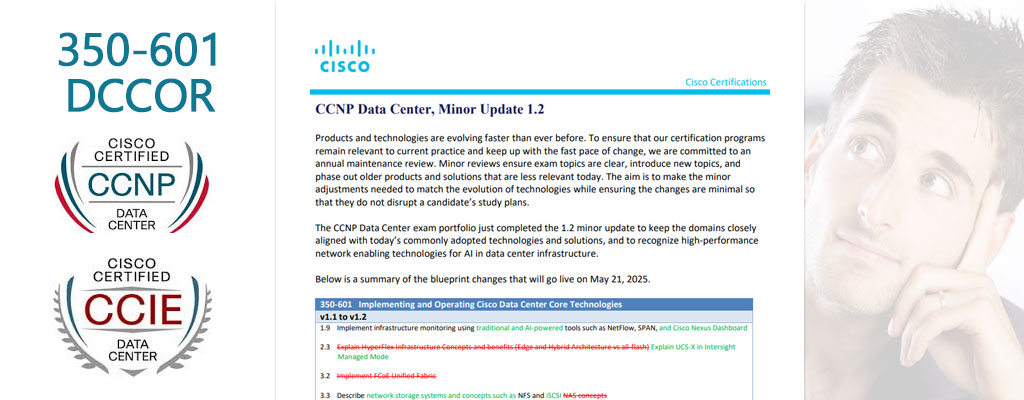
🔍What the 350-601 DCCOR Exam Really Is
Official Definition vs Real-World Role
The 350-601 DCCOR exam is Cisco’s core professional-level validation for data center engineers. It tests your ability to implement technologies across network, compute, storage, automation, and security, forming the foundation of both CCNP and CCIE Data Center tracks.
That’s the official description. The real-world interpretation is more nuanced.
This exam doesn’t measure isolated configuration skills—it evaluates whether you understand how modern data centers behave as integrated systems. In practice, engineers deal with overlay networks, policy-driven fabrics, automation pipelines, and telemetry-driven troubleshooting. The exam reflects that shift by emphasizing decision-making over memorization.
The closer your mindset is to “design + troubleshoot under constraints,” the more aligned you are with how DCCOR is actually assessed.
Certification Outcomes and Career Impact
Passing the exam grants the Cisco Certified Specialist – Data Center Core certification and fulfills the core requirement for CCNP Data Center and CCIE Data Center.
In 2026, employers interpret this certification differently than a few years ago. It signals:
- Competency in fabric-based networking (ACI, VXLAN EVPN)
- Exposure to policy-driven infrastructure
- Awareness of automation workflows and APIs
It’s no longer just networking—it’s infrastructure engineering with software awareness.
📘 Official Exam Topics Breakdown (v1.2 Updated)
Network Domain (25%) with AI Monitoring Updates
The network domain still carries the largest weight (~25%) and includes routing (OSPF, MP-BGP), switching (vPC, LACP), and overlays like VXLAN EVPN.
What’s changed in v1.2—and often overlooked—is the addition of:
- AI-powered monitoring tools (e.g., Nexus Dashboard)
- Enhanced telemetry and assurance concepts
These updates indicate Cisco’s shift toward intelligent observability, not just configuration.
Compute & Storage Domains Reality
Compute focuses on Cisco UCS architecture, firmware lifecycle, and system design. Storage covers Fibre Channel, VSANs, and FCoE.
Here’s a key correction and insight:
- Storage is not just theory-heavy—it includes operational understanding of SAN behavior
- UCS is not optional knowledge—it’s heavily represented in real exam scenarios (aligned with industry feedback patterns)
Many candidates underestimate these domains because they seem “secondary” in the blueprint.
They aren’t.
Automation & Security Domains Evolution
Automation (~15%) includes APIs, scripting concepts, and integration models.
However, the blueprint clarifies something subtle: automation is still conceptual-heavy, not deep coding. That means:
- You’re tested on understanding workflows, not writing complex scripts
- Questions often revolve around choosing the right automation approach
Security appears mostly in contextual scenarios, not standalone deep dives.
⚠️ What Actually Shows Up in the Exam
High-Frequency Topics Candidates Report
Real exam patterns consistently emphasize:
- VXLAN EVPN control plane behavior
- Cisco ACI policy model (tenants, contracts, EPGs)
- UCS architecture and configuration logic
- Packet flow analysis across overlays
These align directly with Cisco’s blueprint—but with deeper practical framing.
Low-Impact Topics Overstudied
Based on blueprint interpretation:
- NIST cloud definitions → low depth
- Basic protocol definitions → rarely tested deeply
- Legacy features (e.g., OTV reduced relevance in newer blueprint versions)
The official document itself states topics are guidelines, not guarantees, meaning not all carry equal weight.
🔁 Blueprint vs Real Exam Gap
Depth vs Breadth Mismatch
Cisco presents a wide blueprint, but the exam favors depth in fewer domains.
| Domain | Official Weight | Real Exam Behavior |
|---|---|---|
| Network | 25% | Deep + scenario-heavy |
| Compute | 25% | Practical + architecture-focused |
| Storage | 20% | Moderate depth |
| Automation | 15% | Conceptual + rising importance |
| Security | 15% | Context-based |
This mismatch explains why many candidates feel “surprised” despite covering all topics.
Scenario-Based Weighting
The exam is heavily scenario-driven, even in multiple-choice format.
You’re often required to:
- Interpret configurations
- Predict behavior
- Identify root causes
This aligns with Cisco’s goal: validating operational readiness, not theoretical recall.
❌ Common Failure Patterns
Misjudging ACI & VXLAN Depth
Candidates often treat ACI as optional. That’s a mistake.
ACI is explicitly listed in the blueprint and tested through:
- Policy relationships
- Fabric behavior
- Integration with overlays
VXLAN EVPN requires BGP understanding, not just overlay definitions.
Ignoring UCS & Storage Complexity
Another frequent failure point:
- Lack of UCS hands-on exposure
- Weak understanding of Fibre Channel and VSANs
These topics appear deceptively simple—but questions often combine them with real-world troubleshooting scenarios.
📈 2026 Trends Reshaping 350-601 DCCOR
AI Infrastructure & Cisco Roadmap 🤖
Cisco’s certification roadmap now includes AI-focused data center exams (e.g., 300-640 DCAI launching 2026), signaling a major shift.
This impacts 350-601 DCCOR indirectly:
- More emphasis on telemetry and analytics
- Increased relevance of intelligent infrastructure monitoring
The direction is clear—data centers are becoming AI-aware systems.
Automation Integration Across Domains
Automation is no longer a separate skill. It’s embedded in:
- Network provisioning
- Policy deployment (ACI)
- Monitoring workflows
Cisco is gradually aligning DevNet and infrastructure tracks, meaning future engineers must operate across both.
🧠 High-ROI Study Strategy
Priority Topics
Focus your effort where it matters most:
- VXLAN EVPN (deep understanding)
- Cisco ACI (policy + architecture)
- UCS fundamentals
- Packet flow and troubleshooting
These deliver the highest return.
Deprioritized Areas
Spend minimal time on:
- Basic cloud theory
- Entry-level protocol definitions
- Rarely tested legacy topics
Smart preparation is about optimization, not coverage.
🧩 Certification Path Positioning
CCNA → CCNP → CCIE Path
The structure remains:
- CCNA → foundational networking
- 350-601 DCCOR → core data center knowledge
- CCNP → specialization
- CCIE → expert-level validation
350-601 DCCOR is the pivot point.
DevNet & Automation Alternative
Cisco’s ecosystem is shifting toward automation-centric roles.
If your goal is:
- Infrastructure + scripting → DCCOR + DevNet
- Pure development → DevNet first
The lines are blurring.
PS. 🔄 DevNet → Automation Track (Major Shift)
Cisco has officially rebranded and repositioned DevNet certifications into a new track called:
➡️ Automation Certifications
This change took effect around February 3, 2026.
New structure:
- DevNet Associate → CCNA Automation
- DevNet Professional → CCNP Automation
- DevNet Expert → CCIE Automation
👉 So yes — the DevNet “name” is fading out, replaced by a more traditional Cisco naming system.
📚 Resources & Practice Strategy
Official Cisco Sources
Best starting points:
These define what Cisco expects—not how the exam feels.
Practice & Validation Tools
To bridge the gap between blueprint and reality, candidates often use:
- Scenario-based practice platforms
- Community-shared question patterns
- Supplementary sources like https://www.leads4pass.com/350-601.html
There’s also mention of curated 350-601 DCCOR PDF collections of recent practice questions, which help simulate real exam logic when used responsibly.
🤔 Final Decision Insight
When It’s Worth It
- You work with Cisco Nexus, ACI, or UCS
- You aim for CCNP/CCIE Data Center
- You want to stay relevant in hybrid infrastructure environments
When It’s Not
- Your work is purely cloud-native (AWS/GCP only)
- You don’t interact with Cisco ecosystems
- You prefer development over infrastructure
The real question isn’t whether you can pass 350-601 DCCOR.
It’s whether your career direction aligns with programmable, policy-driven, and AI-assisted data centers.
If it does, this certification is not optional—it’s foundational.
If it doesn’t, it’s just another badge.
FAQs
1. Is DCCOR updated in 2026?
Yes, Cisco introduced minor updates (v1.2), including AI-powered monitoring tools and refined topics.
2. Does the exam include labs?
No full lab simulations, but strong scenario-based questions are common.
3. How important is ACI?
Critical. It’s explicitly listed and heavily tested conceptually.
4. Is automation difficult in DCCOR?
Not deeply technical—focus is on understanding workflows and tools.
5. How long should preparation take?
Typically 2–4 months depending on prior experience.

Recent Comments