 exam
examPreparing for the Cisco 300-540 SPCNI exam can become frustrating when hours of reading and practice produce little confidence about your actual readiness. The problem is often not a lack of study time, but a lack of useful feedback. You need to know which concepts you understand, where your reasoning breaks down, and whether you can apply what you have learned to unfamiliar technical scenarios. A better preparation process turns those uncertainties into specific decisions about what to study next.
Cisco describes the 300-540 SPCNI exam as a 90-minute assessment covering virtualized architecture, cloud interconnect, high availability, security, and service assurance and optimization. It also serves as a concentration exam option for the CCNP Service Provider certification.
These details define the scope but do not tell you how to prepare efficiently. Use Cisco 300-540 dumps (https://www.leads4pass.com/300-540.html) to enhance your experience, identify knowledge gaps, and develop the ability to articulate the technical decisions behind the answers.
1. Find Out What You Actually Know Before You Start
The most efficient Cisco 300-540 exam preparation begins with an honest assessment of your current knowledge. If you already work with service provider networks, you may be comfortable with routing and network operations but less familiar with virtual network functions, orchestration, or cloud interconnect models. Another candidate might understand virtualization well but struggle to reason through service provider high-availability or security scenarios. Following the same study schedule would waste time for at least one of you.
Start with a small set of diagnostic questions covering different areas of the exam. Use the results to identify topics that deserve further investigation, not to predict your final score. When you miss a question, record whether the cause was a missing concept, confusion between similar technologies, an incorrect assumption, or difficulty applying familiar knowledge to a new situation.
This distinction matters. A knowledge gap requires learning; a reasoning error requires a different kind of practice. If you cannot explain a concept without looking at your notes, rereading the same page may create familiarity without building reliable understanding. If you know the technology but choose an unsuitable design, you need to work on the conditions that determine which solution makes sense.
Build a simple study record with three categories: understood, needs review, and cannot yet explain confidently. Update it as you study. Your objective is not to eliminate every weakness immediately, but to make your next study session more purposeful than the last one.
2. Prioritize Weak Areas Instead of Studying Everything Equally
Once you have a baseline, organize your study time around the weaknesses that matter most. Cisco’s published 300-540 exam topics provide the reference point for deciding what is relevant; your diagnostic results help determine where your effort is needed. The two serve different purposes. One defines the scope of preparation, while the other helps you decide where to begin.
A practical approach is to consider both the importance of a topic and the depth of your understanding. A subject you can define but cannot apply deserves more attention than one you can explain, compare, and use to evaluate a technical decision. Likewise, a familiar technology should not automatically receive less attention if you repeatedly make mistakes when answering scenario-based questions.
For example, knowing what network functions virtualization (NFV) means is different from understanding how virtual network functions are onboarded and managed through orchestration. Recognizing the names of cloud connectivity options is also different from comparing their suitability for a particular service provider environment. Cisco’s official training outline includes these broader implementation and verification skills, making it useful as a reference when your study starts becoming too theoretical.
Try this review cycle:
- Choose one weak concept and revisit the relevant documentation or learning material.
- Explain the concept in your own words, including its purpose and limitations.
- Apply it to a technical scenario or practice question.
- Reassess the topic later with a fresh question rather than immediately repeating the same one.
This process creates a clearer link between learning and performance. It also prevents a common preparation trap: spending another hour on a comfortable topic because progress feels easier there.
3. Use Practice Questions to Test Your Reasoning
Practice questions can be valuable during Cisco 300-540 SPCNI preparation, but their usefulness depends on how you review them. A correct answer does not always demonstrate understanding. You might recognize familiar wording, remember an option from an earlier attempt, or arrive at the right answer through an assumption that would fail in a different scenario.
To get more value from a practice session, treat each question as a small technical investigation. Before checking the explanation, identify the problem being tested, the conditions that constrain the solution, and the reason your chosen option fits those conditions. After answering, examine why the other plausible options are less suitable. If you cannot explain the distinction, you have found something worth studying even when your answer was correct.
Consider a question about selecting a connectivity approach for a cloud-connected service provider environment. Memorizing a definition may help you recognize the terminology, but it will not necessarily help you evaluate the requirements of a new scenario. You need to understand what the options offer, what limitations they introduce, and which requirements make one approach more appropriate than another.
Incorrect answers deserve particular attention. Instead of simply recording the correct option, write down the misconception that led you astray. Perhaps you confused two related mechanisms, overlooked a requirement, or assumed that a familiar solution was suitable in every environment. Then revisit the underlying concept and test yourself again with a different question.
Repeatedly memorizing answer patterns can create a misleading sense of readiness. Even a large number of correct responses is weak evidence if you cannot explain the decisions behind them. Practice materials should help you discover what you need to learn, not replace learning itself.
Free Cisco 300-540 Practice Questions
Use these free practice questions to check your understanding, identify areas that need more review, and decide what to study next. Focus on the reasoning behind each answer, not just whether you selected the correct option.
| Share online | Get more | Authorization | Notice |
| 15 Free Questions | Cisco 300-540 Exam Preparation Materials (Web TestEngine also allows for online practice simulations.) | To gain recognition from Leads4Pass | Obtain exam answers from Leads4Pass, with support for online printing. |
Question 1
Multiple choice
Refer to the exhibit.
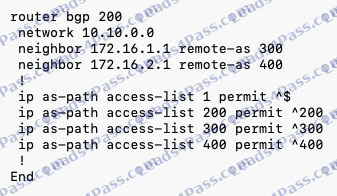
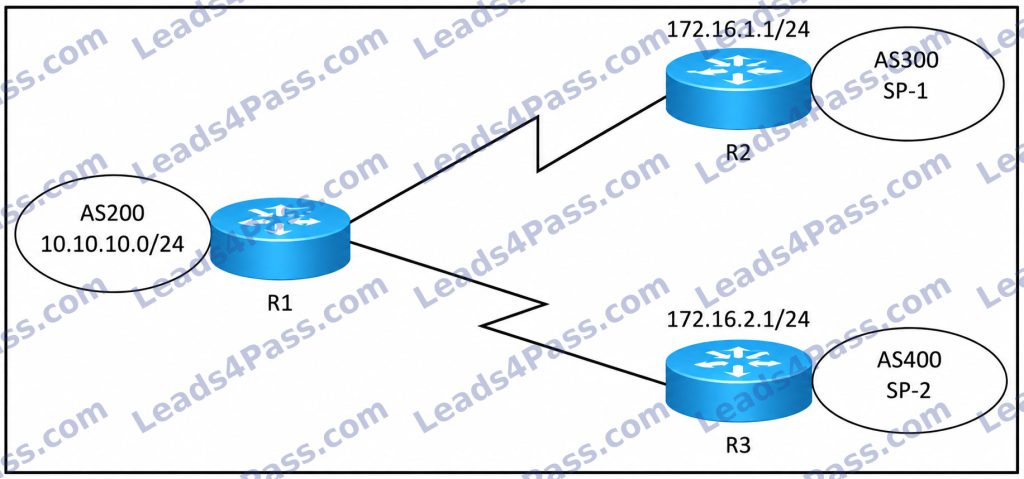
An engineer must configure multihoming between router R1 and service providers SP-1 and SP-2. Locally generated routes must be advertised to the service providers, and should prevent the risk that the local autonomous system becomes a transit AS for Internet traffic.
Which two commands must be run on R1 to complete the configuration? (Choose two.)
A.neighbor 172.16.1.1 filter-list 300 out
B.neighbor 172.16.2.1 filter-list 400 out
C.neighbor 172.16.1.1 filter-list 1 out
D.neighbor 172.16.2.1 filter-list 1 out
E.neighbor 172.16.1.1 filter-list 200
Question 2
Single choice
Refer to the exhibit.
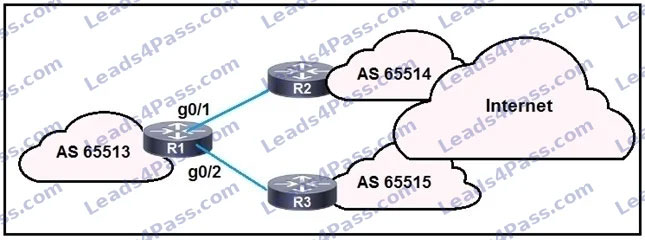
R1 is connected to two service providers and is under a DDoS attack.
Which statement is true if uRPF strict mode is configured on both interfaces?
A.R1 drops a packet when the best FIB route to its source address exits an interface other than the one on which the packet arrived.
B.R1 drops packets whose destination addresses are routed to a null interface.
C.R1 permits asymmetric routing when the AS-path attribute matches the connected AS.
D.R1 automatically accepts private source addresses on GigabitEthernet0/1.
Question 3
Single choice
What is a valid connection method between carrier-neutral facilities within the same metro area?
A.OSPF backbone area adjacency
B.private wireless connection
C.DWDM ring
D.CAT6e connection
Question 4
Single choice
How does log management assist in meeting the requirements of cloud security regulatory compliance?
A.by supporting documentation and reporting processes
B.by streamlining resource allocation across cloud environments
C.by providing enhanced interoperability between cloud platforms
D.by boosting the security of cloud-based applications
Question 5
Single choice
Which configuration mode is used to apply the mpls ldp graceful-restart command in Cisco IOS XE Software?
A.MPLS LDP neighbor
B.interface
C.MPLS
D.global
Question 6
Single choice
An engineer attempts to kill a NETCONF session. The session ID is equal to the current session.
What is the effect of this action?
A.An invalid-value error is returned, and the current user is not logged out.
B.The session is terminated, and all the connected users are logged out.
C.The configuration is saved, and the current user is logged out.
D.The configuration is removed, and the current user is logged out.
Question 7
Single choice
Refer to the exhibit.
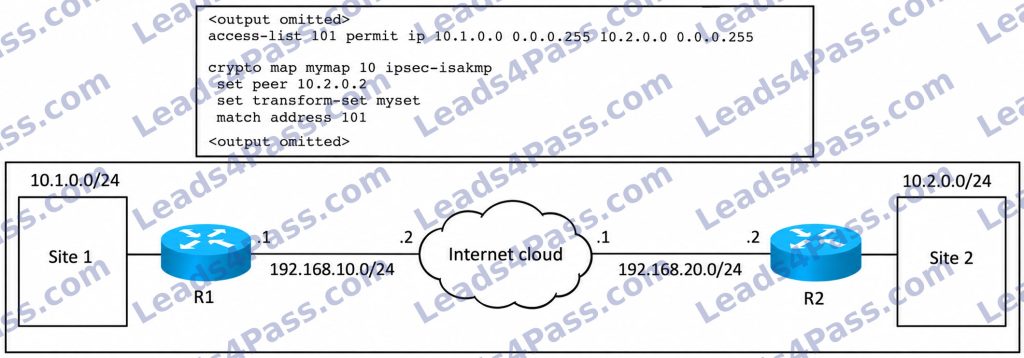
An engineer must configure an IPsec VPN connection between site 1 and site 2. The indicated configuration was applied to router R1; however, the tunnel fails to come up.
Which command must be run on R1 to resolve the issue?
A.set peer 10.1.0.1
B.set peer 192.168.20.2
C.set peer 192.168.10.1
D.set peer 10.2.0.1
Question 8
Single choice
A network engineer must configure an OSPF helper router to terminate the graceful restart process if the helper detects any LSA changes.
Which command enables this feature?
A.nsf ietf helper disable
B.nsf cisco helper disable
C.nsf ietf helper strict-lsa-checking
D.nsf cisco enforce global
Question 9
Single choice
Refer to the exhibit.
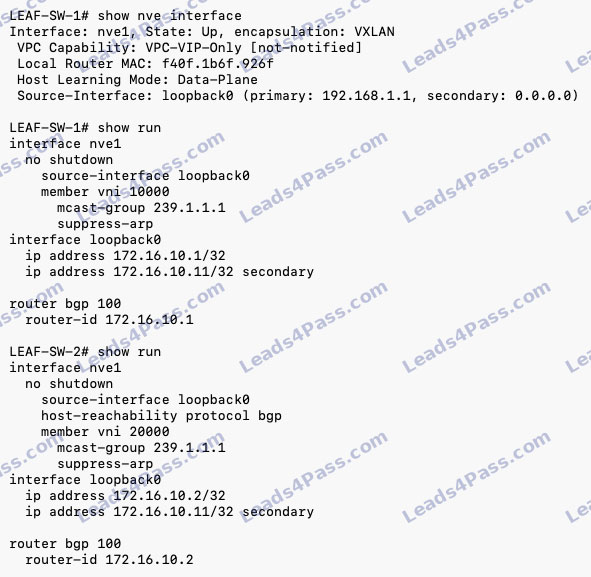
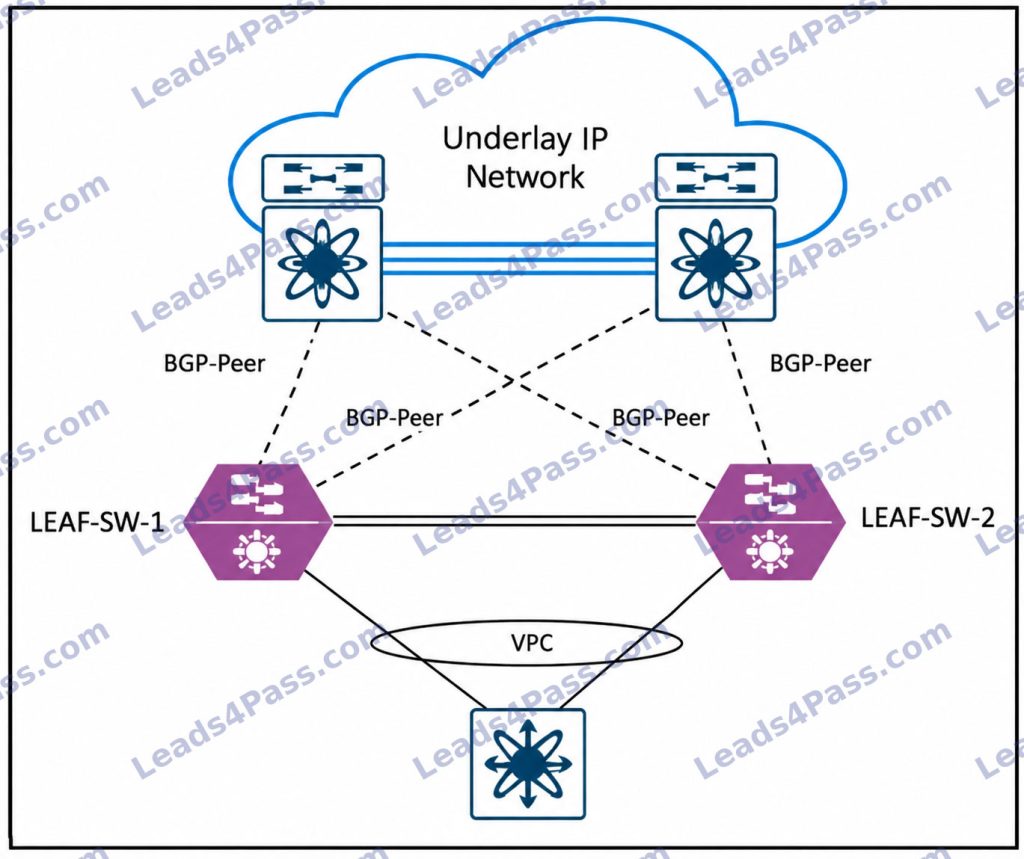
An engineer is troubleshooting an issue where switch LEAF-SW-1 and switch LEAF-SW-2 receive corrupted forwarding and learning information about each other. LEAF-SW-1 and LEAF-SW-2 are configured with BGP EVPN VTEP.
Which action resolves the issue?
A.On each switch, run the delete suppress-arp command against interface nve1.
B.On each switch, configure a different secondary IP address against interface loopback0.
C.On LEAF-SW-1, run the host-reachability protocol bgp command against interface nve1.
D.On each switch, ensure the same BGP router ID is configured.
Question 10
Single choice
Refer to the exhibit.
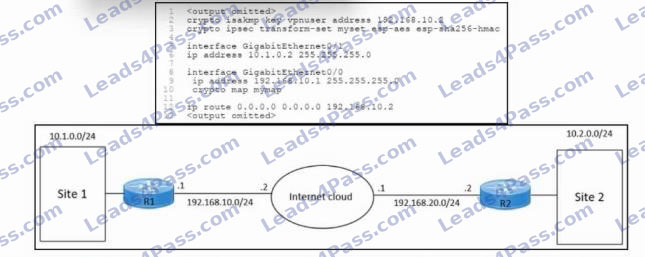
An engineer must configure an IPsec VPN connection between site 1 and site 2. The indicated configuration was applied to router R1; however, the tunnel fails to come up.
Which command must be run on R1 to resolve the issue?
Dcrypto isakmp key vpnuser address 10.1.1.2After completing the questions, review the ones you answered incorrectly and the ones you answered correctly for uncertain reasons. Those two groups often reveal more about your preparation needs than your overall score alone.
A.ip route 0.0.0.0 0.0.0.0 10.1.1.2
B.crypto isakmp key vpnuser address 192.168.20.2
C.ip route 0.0.0.0 0.0.0.0 192.168.20.2
D.crypto isakmp key vpnuser address 10.1.1.2
Question 11
Multiple choice
Refer to the exhibit.
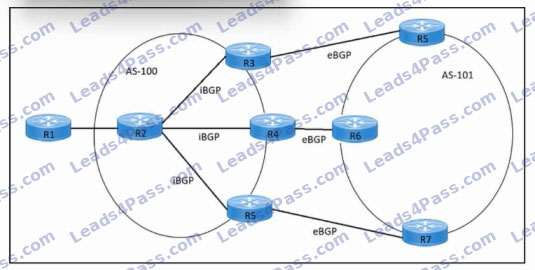
An engineer must configure iBGP multipath load sharing across three paths.
Which two commands must be run on router R2? (Choose two.)
A.router bgp 100
B.ip load-sharing ibgp 3
C.maximum-paths ibgp 3
D.router bgp 101
E.ip load-sharing per-destination
Question 12
Single choice
Volumetric traffic to one /32 is exhausting shared upstream capacity. The edge routers do not support FlowSpec, and sacrificing reachability to that address is acceptable. Which response is appropriate?
A.Install an ACL on the destination host so unwanted traffic crosses the provider network before discard.
B.Enable strict uRPF because source validation selectively removes every flow sent to the victim.
C.Advertise the /32 under controlled RTBH policy so edge routers resolve it to a discard next hop.
D.Enable MACsec on the upstream links because hop-by-hop encryption reduces the attack volume.
Question 13
Single choice
An engineer must create a new VPC and deploy several Amazon EC2 instances in AWS. Only SSH connections originating from IP address 20.20.20.20 must be allowed to reach the EC2 instances.
What must be configured?
A.Access control list
B.Security group
C.Web application firewall
D.Resource group
Question 14
Single choice
An engineer must design a cloud platform forevent-driven applications. The solution must allowmicro-sized atomic componentsto be built, deployed, and run code on demand.
Which solution must be used?
A.Cisco+ Hybrid Cloud for Virtual Desktop Infrastructure
B.Cisco FaaS
C.Cisco+ Hybrid Cloud Virtualization
D.Cisco Intersight
Question 15
Single choice
Refer to the exhibit.
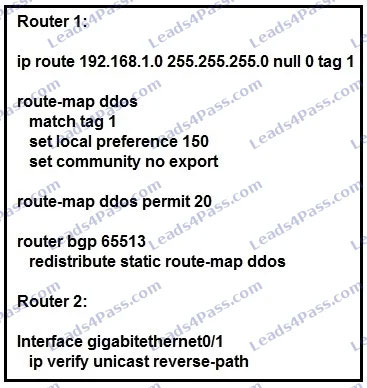
An engineer is preparing to implement data-plane security.
Which statement about this configuration is true?
A.Router 2 is the router receiving the DDoS attack.
B.Router 1 must be configured with uRPF for the RTBH implementation to be effective.
C.Router 1 is the trigger router in an RTBH implementation.
D.Router 2 must configure a static route to Null0 for 192.168.1.0/24 to complete the RTBH implementation.
After completing the exercises, obtain the correct answers from “https://www.leads4pass.com/300-540/questions.html” to verify your work, then review the questions you answered incorrectly as well as those you answered correctly but without full confidence. Compared to a simple total score, these two types of questions often better reflect your specific needs regarding exam preparation.
4. Learn to Recognize Understanding, Not Just Familiarity
One useful test is whether you can explain a technical decision without relying on the wording of a practice question. This does not mean you need to reproduce a textbook definition. It means you can describe what a technology does, when it is appropriate, what trade-offs it introduces, and how it relates to the problem you are trying to solve.
For service provider cloud networking, that ability matters across several connected areas. Virtualization, cloud connectivity, high availability, security, and service assurance are not isolated vocabulary lists. A design decision can affect operational visibility, resilience, or the way a service is delivered. Studying these relationships helps you move beyond recognizing individual terms.
Try changing the conditions of a question after you have reviewed its answer. If a scenario assumes a particular connectivity requirement, ask yourself how your decision would change if that requirement changed. If a design prioritizes availability, consider which failure conditions it must address. You do not need to invent Cisco exam questions or predict the live exam. You are training yourself to reason about the technologies in the published scope.
Official Cisco documentation and relevant technical learning materials can help you verify your explanations. When two technologies appear similar, compare their purposes and limitations rather than memorizing separate definitions. If your explanation depends on vague phrases such as “it is more efficient” or “it is more secure,” investigate what that actually means in the scenario.
This method takes more effort than reviewing an answer key, but it gives you a stronger indication of whether your knowledge can transfer to unfamiliar problems.
5. Know When You Are Ready to Take the Exam
There is no single practice score that can reliably establish readiness for every candidate. Your results depend on the quality and relevance of the questions, whether you have seen them before, and how consistently you can apply your knowledge. One unusually strong session is encouraging, but it should not be the only evidence behind your decision to schedule the exam.
Look for a pattern across several independent indicators:
- Consistent performance: You answer fresh practice questions correctly across the areas you have studied.
- Clear reasoning: You can explain why an answer fits the scenario and why the plausible alternatives do not.
- Improved weak areas: Topics that previously caused repeated mistakes are becoming easier to explain and apply.
- Transferable knowledge: You can work through variations of a problem without depending on memorized wording.
- Controlled pacing: You can complete practice sessions within the available time while still reading questions carefully and checking your reasoning.
If your performance fluctuates, investigate the cause before adding more study hours. Are the questions testing different concepts? Are you rushing? Do you understand the material but misread the requirements? Or have you become familiar with a limited set of answers without developing broader knowledge?
Each cause calls for a different response. A candidate who struggles with timing needs a different intervention from someone who consistently misunderstands technical concepts. Make adjustments based on the evidence, then reassess with fresh questions.
Readiness does not mean knowing every possible detail. It means having credible evidence that your knowledge is broad enough, your reasoning is dependable, and your remaining weaknesses are understood rather than ignored.
6. Make Your Final Review Count
During the final stage of Cisco 300-540 exam preparation, resist the temptation to restart your entire study plan. Review the concepts that repeatedly cause problems, revisit your notes on important distinctions, and use a short practice session to check whether earlier weaknesses have improved.
Avoid treating last-minute memorization as a substitute for understanding. If a concept remains unclear, focus on its underlying logic and consult reliable technical documentation. If you are making avoidable mistakes because of rushing, practice reading the complete scenario before selecting an answer.
Cisco lists the 300-540 SPCNI exam as a 90-minute assessment.
Cisco Use timed practice to become comfortable managing your attention within that limit, but do not assume your practice environment reproduces the live exam’s exact format or difficulty.
Before scheduling, check the current official exam information and topics. Give yourself enough time to address meaningful gaps rather than choosing a date solely to create pressure. A realistic preparation plan should help you make a sound decision, not keep you studying indefinitely.
7. Choosing Additional Practice Resources
Once you have a consistent study process, additional practice material can help you check your understanding and identify areas that need another review. The important question is not how many questions a resource contains, but whether using it helps you recognize gaps and improve your reasoning.
Leads4Pass offers an optional resource for candidates preparing for Cisco 300-540 SPCNI. You can review the available material on the Leads4Pass Cisco 300-540 exam preparation page (https://www.leads4pass.com/300-540.html). Check the product details and available samples before deciding whether the resource suits your learning preferences and preparation needs.
Use any practice resource alongside your technical study, not as a replacement for it. Review explanations where available, investigate uncertain answers, and return to the underlying concepts when you encounter a weakness.
The most useful resource is one that fits into a disciplined learning process: identify a gap, study the concept, test your understanding, and verify that you can apply what you learned. That approach remains useful regardless of which study materials you choose.
Conclusion
Effective Cisco 300-540 exam prep is less about accumulating study hours than making those hours productive. Start by identifying your actual weaknesses, prioritize topics according to your needs, and use practice questions to examine your reasoning rather than memorize answers. Track your progress with fresh questions and look for consistent evidence that you can explain technical decisions, handle unfamiliar scenarios, and manage your time.
The goal is not to feel prepared because the material looks familiar. It is to build enough understanding to approach a technical problem, recognize the relevant constraints, and justify your answer. When your preparation consistently demonstrates those abilities, you have a much stronger basis for deciding when to take the exam.

 Kyle Bray
Recent Comments