 exam
exam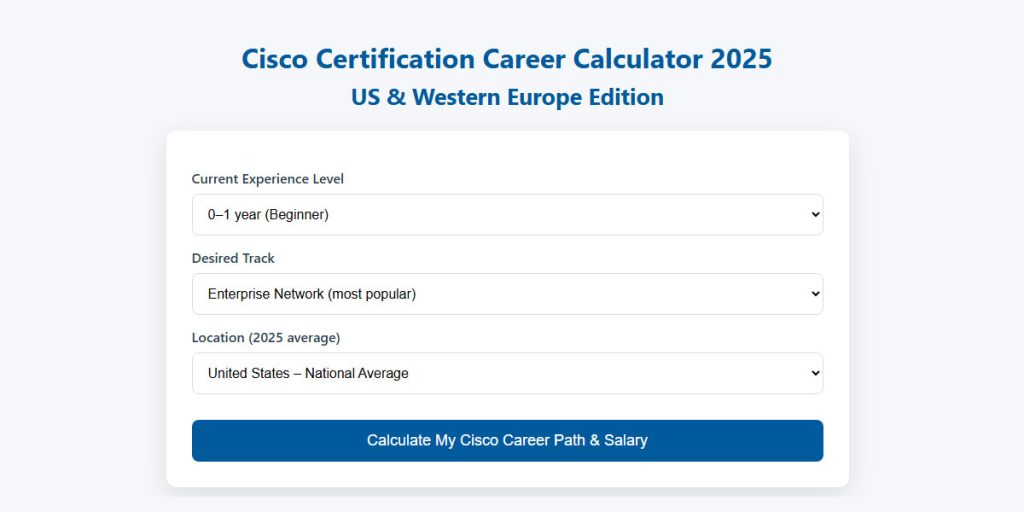
In 2025, the demand for Cisco-certified professionals has never been stronger. With global enterprises accelerating cloud adoption, zero-trust security, AI-driven networking, and hybrid infrastructure, Cisco certifications continue to stand as the most recognized and job-relevant credentials in the networking and cybersecurity industry.
According to Cisco’s public workforce report, more than 80% of global enterprises rely on Cisco technologies, which directly increases the need for certified engineers in roles such as network operations, security engineering, and systems architecture.
This guide breaks down every Cisco certification level, offers career path recommendations, provides salary insights, and incorporates fresh updates for 2025.
Understanding Cisco Certification Levels
Cisco certifications are divided into five main levels: Entry, Associate, Professional, Expert, and Architect. Currently, there are over 50 certifications available online, covering networking, security, data centers, collaboration, DevNet (automation), and emerging AI fields. Certifications are valid for 3 years and require renewal through continuing education (CE) credits or re-examination.

Entry Level – CCST
Cisco’s Certified Support Technician (CCST) provides the absolute starting point for IT newcomers. It covers networking fundamentals, security basics, troubleshooting, and hands-on essentials required for junior roles.
Associate Level – CCNA
The CCNA 200-301 exam remains the most globally recognized networking certification and serves as a baseline for network roles across industries. It verifies skills such as IPv4/IPv6, routing, VLANs, automation, and basic security.
Professional Level – CCNP
CCNP certifications allow specialization across enterprise, security, data center, collaboration, and service provider domains.
Expert Level – CCIE & CCDE
CCIE remains one of the most respected expert-level IT certifications. CCDE focuses on design and architecture. Both require deep expertise and hands-on capability.
Specializations
Cisco also offers niche credentials, such as DevNet, CyberOps, SD-WAN, and Collaboration specialization.
The Updated 2025 Cisco Certification Framework
Cisco’s 2025 updates emphasize flexibility, modularity, and automation. All certification levels now integrate:
- SDN/SD-WAN fundamentals
- Cloud security
- DevNet automation basics
- AI-enhanced troubleshooting
Cisco also refined the credit-based recertification system, allowing professionals to maintain credentials by completing training or passing exams.
Note: Starting in 2026, DevNet will be renamed to the Automation series, and Network Security will be expanded to CCNA/CCNP Network Security. Specialization certifications can be obtained independently and used for recertification or career advancement.

With these updates shaping how professionals learn and stay certified, it’s easier to understand how each level fits into Cisco’s modernized structure. The next sections break down these certification levels in detail, starting with the foundational CCST and moving upward through the entire Cisco hierarchy.
CCST – The Foundation Step
Perfect for newcomers, computer science graduates, or career changers.
Skills you gain:
- Device setup basics
- Intro network troubleshooting
- Security awareness
- Ticket-handling workflows
Relevant job roles:
- IT Support Technician
- Junior Network Technician
- Help Desk Analyst
CCNA – The Most Popular Starting Point
CCNA continues to dominate entry-level IT networking certifications because it aligns with real-world job responsibilities.
Latest 2024–2026 CCNA Updates
- Revised automation module
- Updated wireless and security coverage
- Cloud networking essentials
- Enhanced IPv6 troubleshooting
Why Employers Value CCNA
A 2025 hiring survey revealed that 67% of network engineer job postings list CCNA as a preferred or required qualification.
CCNP Tracks Explained
Each CCNP track requires one core exam + one concentration exam.
CCNP Enterprise
Ideal for networking professionals working with switching, routing, wireless, SD-WAN.
CCNP Security
A strong path for cybersecurity roles, covering firewalls, VPNs, zero trust, identity protection.
CCNP Data Center
Focuses on Cisco UCS, ACI, and storage networking.
CCNP Collaboration
Supports VoIP, Webex, unified communications.
CCNP Service Provider
Specialized track for SP infrastructure and carrier-grade networking.
Salary Table (2025 U.S. Average)
| Certification | Average Salary (2025) | Demand Level | Typical Role |
|---|---|---|---|
| CCNA | $82,000 | Very High | Network Technician |
| CCNP Enterprise | $116,000 | High | Network Engineer |
| CCNP Security | $128,000 | Very High | Security Engineer |
| CCIE | $178,000 | High | Network Architect |
| CCDE | $185,000 | Medium | Solutions Architect |
These salary ranges highlight how each Cisco certification level directly shapes earning potential and job competitiveness. With clearer differences between tracks, professionals can make more strategic decisions when selecting the most suitable path. This leads us into a deeper look at the expert-level certifications—CCIE and CCDE—and why they continue to hold exceptional value in 2025.
CCIE & CCDE – Elite Expert Certifications
CCIE (Enterprise, Security, DC, SP, Collaboration)
Cisco updated the 2025 lab exam to include:
- AI-assisted troubleshooting modules
- SD-WAN multi-cloud integration
- Network automation pipelines
A 2025 employment index shows CCIE holders earn 2–3× more than non-certified engineers.
CCDE (Design Expert)
Focused on architecture, modeling, and large-scale design decisions. Highly valued by enterprises and consulting firms.
Comparing Cisco Tracks
| Track | Difficulty | Salary | Best For | Job Demand |
|---|---|---|---|---|
| Enterprise | Medium | High | General network engineers | Very High |
| Security | High | Very High | Cybersecurity roles | Very High |
| Data Center | Medium | Very High | Cloud & DC engineers | High |
| Collaboration | Medium | Medium | VoIP, UC engineers | Moderate |
| Service Provider | High | High | Telecom environments | Niche |
Understanding how each track differs in difficulty, demand, and career focus makes it easier to evaluate long-term growth potential. These distinctions also translate directly into real-world compensation, which is why taking a closer look at the 2025 salary landscape is essential before choosing your certification path.
Salary Statistics for 2025
U.S. vs. Global Comparison
| Region | CCNA | CCNP | CCIE |
|---|---|---|---|
| U.S. | $82K | $120K | $178K |
| Europe | €55K | €78K | €130K |
| Asia | $25K–$45K | $40K–$70K | $82K–$120K |
With these salary insights in mind, the next step is understanding how different professionals can navigate Cisco’s certification ecosystem based on their background and goals. The following path scenarios provide practical examples to help you choose the most effective route for your career.
Industries with highest Cisco hiring demand:
- Finance
- Healthcare
- Cloud service providers
- Cybersecurity companies
- Government agencies
Certification Path Scenarios
1. Beginners
Start → CCST → CCNA → CCNP Enterprise
Great for long-term networking careers.
2. Cybersecurity Focus
Start → CCNA → CCNP Security → CCIE Security
Demand grows due to zero-trust adoption.
3. Cloud / Automation Roles
Start → CCNA → DevNet Associate → CCNP Enterprise + Automation concentration
4. Data Center Professionals
Start → CCNA → CCNP Data Center → CCIE Data Center
Recommendation: Update your knowledge annually and pay attention to the 2025 updates (such as the CCNA v1.1 automation module). Beginners should prioritize the Networking track, while security enthusiasts should choose Cybersecurity.
These tailored pathways show how flexible the Cisco certification ecosystem can be for different career stages. To give these scenarios more real-world context, the next section highlights actual success stories from 2025, demonstrating how professionals have used these certifications to accelerate their careers.
Real 2025 Career Case Studies

Case Study 1 – Switching to Cybersecurity
A network engineer with 3 years of experience used CCNP Security to transition into a SOC role. Salary increased by 33%.
Case Study 2 – From Data Center Technician to Architect
A technician earning $58K advanced to CCIE Data Center and secured a $150K architect position.
Case Study 3 – Fresh Graduate Breakthrough
A CS graduate obtained CCNA and quickly landed a junior network role within 2 months.
Tools and Resources
Official Cisco Links:
Useful Study Platforms
- Packet Tracer (Cisco)
- GNS3
- EVE-NG
- Leads4Pass
- Youtube
With the right tools and study platforms in place, planning your certification journey becomes far more efficient. To make this process even easier, the next section introduces a customizable HTML career calculator you can embed directly into your workflow to instantly map out your ideal Cisco path.
Cisco Planning Tools
This interactive tool helps you instantly determine the most suitable Cisco certification career path based on your current experience, preferred track, and 2025 salary data across different regions. Simply select your experience level, target certification track, and location — the tool will calculate the optimal training roadmap and expected salary outcomes. Use it to plan your next step with precision and confidence.
Conclusion
In 2025 and beyond, Cisco certifications will continue to be one of the most reliable investments for IT professionals. Whether you’re starting your IT journey, shifting into cybersecurity, or aiming for an expert-level role, Cisco offers a structured and globally recognized pathway. Combined with real-world labs, strong community support, and high industry demand, these certifications can significantly boost your career trajectory and earning potential.
FAQs
1. Is CCNA still worth it in 2026?
Yes. CCNA remains the most in-demand entry-level networking certification.
2. How long does it take to get CCNP?
Most professionals take 4–8 months depending on study time and prior experience.
3. Which Cisco certification is best for cybersecurity?
CCNP Security → CCIE Security offers the highest value.
4. Can beginners start with CCNP?
Not recommended. CCNA or CCST provides essential foundations first.
5. Does Cisco certification increase salary?
On average, certifications increase earnings by 20–70% depending on region and track.


Recent Comments