 exam
exam
Are you ready?
- Are you new to the Cisco field?
- Are you preparing to enter the IT networking industry?
- Are you already part of Cisco?
- Are you gearing up to advance or considering stepping away?
Whatever the case! I invite you to read through my article.
What is Cisco Certification?
Cisco certifications are highly authoritative professional certifications in the field of network engineering, including levels such as CCNA, CCNP, and CCIE, covering various areas from basic networking knowledge to advanced routing, security, wireless, and automation.

- CCNA: Entry-level network engineer certification, covering IP routing and switching fundamentals, basic network security, and automation.
- CCNP: A more advanced network certification, suitable for those looking to deepen their professional expertise.
- CCIE: The industry’s top-tier certification, including a lab exam, representing a high level of professional capability.
These certifications are widely recognized by global enterprises, particularly suitable for career paths in network deployment, operations, and maintenance.
Current State and Trends of the IT Certification Market
The global certification market was valued at approximately $48.9 billion in 2024, projected to grow to $51.6 billion in 2025, with a compound annual growth rate (CAGR) of 5.5% from 2025 to 2033.
Another authoritative data source indicates that the entire IT training market reached $86.49 billion in 2024, expected to grow at a 6.2% CAGR from 2025 to 2034, with its scale continuing to rise in 2025.
This suggests that demand for both certifications and related training services is steadily increasing.
Career Returns and Salary Data
According to the 2024 IT Skills and Salary Report by Global Knowledge and Skillsoft, Cisco certifications such as CCNA and CCNP remain highly sought-after qualifications in global job markets.
- CCNA certification holders earn an average global salary of approximately USD 89,066, and about USD 112,333 in the U.S.;
- CCNP Security certification holders earn a global average of USD 110,851, and USD 168,159 in the U.S.;
- CCIE Enterprise Infrastructure certification holders earn a global average of USD 146,372, and USD 166,524 in the U.S.
Pearson VUE’s 2025 IT Certification Value Report states:
- 32% of certification holders received a salary increase after certification, with 31% experiencing a raise exceeding 20%;
- 63% achieved or anticipated a job promotion;
- 70% improved work efficiency, 79% enhanced work quality, and 76% reported increased innovation capabilities.
New Trends in Cisco Certification System in 2025

This is the second major change. Recall that on February 24, 2020, Cisco revamped its entire certification system. Five years later, starting from February 3, 2026, most certifications will undergo a renewed transformation in tandem with the AI era. This marks a new era for Cisco certifications, as well as the era of the future—the next generation of network career development in the age of artificial intelligence, network automation, and network security.
By integrating DevNet with network/security certifications (such as CCNA, CCNP, CCIE), it creates a clearer and more industry-oriented certification path.
This means that automation and network security skills have become key directions in Cisco certifications, closely aligned with current industry technology advancements. The integration enhances the adaptability of Cisco certifications, helping practitioners build a solid foundation in the intersecting fields of networking, automation, and security.
Competitiveness of Cisco Certifications in 2025
Competitiveness of Cisco Certifications in 2025
Comparison with Cloud Certifications (e.g., AWS, Azure, Google Cloud):
Cloud certifications continue to thrive in 2025, with significant market shares (e.g., AWS at 31%, Azure at 25%). However, foundational networking skills remain essential, particularly in hybrid cloud environments. Professionals holding Cisco certifications combined with cloud skills are more competitive in the job market, often commanding a salary premium of 10-20% on average.
Demand for Networking Talent Amid Digital Transformation Trends:
In the wave of digital transformation, network automation, SD-WAN, and security isolation (e.g., zero-trust models) have become core focus areas. Cisco’s certification updates for 2025 (e.g., CCNP emphasizing cloud-native, automation, and SD-WAN) and upcoming changes in 2026 (integrating AI and DevNet) ensure their certifications remain highly relevant, equipping professionals to adapt to automation- and security-driven network environments.
The Pros and Cons of Investing in Cisco Certifications

| Pron | Cons |
| Strong Brand and Industry Recognition: Cisco certifications maintain high credibility and are widely respected in the networking industry, opening doors to high-demand roles in enterprise environments. | High Costs: Exam and training fees are significant, with CCNA costing approximately $300, and recertification every 3 years adds to expenses. |
| Comprehensive Knowledge Coverage: Offers a systematic curriculum from foundational (CCNA) to advanced (CCNP, CCIE), ensuring well-rounded networking expertise applicable across various IT setups. | Frequent Updates: Regular exam revisions require continuous learning and maintenance to stay current, which can be time-consuming. |
| Alignment with Emerging Technologies: Integrates automation, security (e.g., zero-trust), and SD-WAN, keeping professionals competitive in modern, cloud-driven, and secure network environments. | Competition from Specialized Certifications: In emerging fields like cloud infrastructure and security, AWS, Azure, and other certifications offer more focused alternatives. |
| Significant Career and Salary Benefits: Certified professionals often see a 10-20% salary premium and better career advancement opportunities in traditional and hybrid IT roles. | Time and Effort Intensive: Preparing for exams demands substantial time and energy, with complex content potentially leading to high failure rates. |
PS. Achieving Cisco certification requires effort, but the rewards are worth it. Candidates should aim to pass on their first attempt to avoid repeated exams.
At Vcecert, you’ll find comprehensive Cisco study materials designed to ensure your success on the first try.
Practical Advice: Should You Invest? How to Choose?
If You’re a Network Engineer or Infrastructure Professional
Prioritize earning the CCNA, and consider advancing to CCNP or specialized certifications in DevNet automation/security to enhance future adaptability.
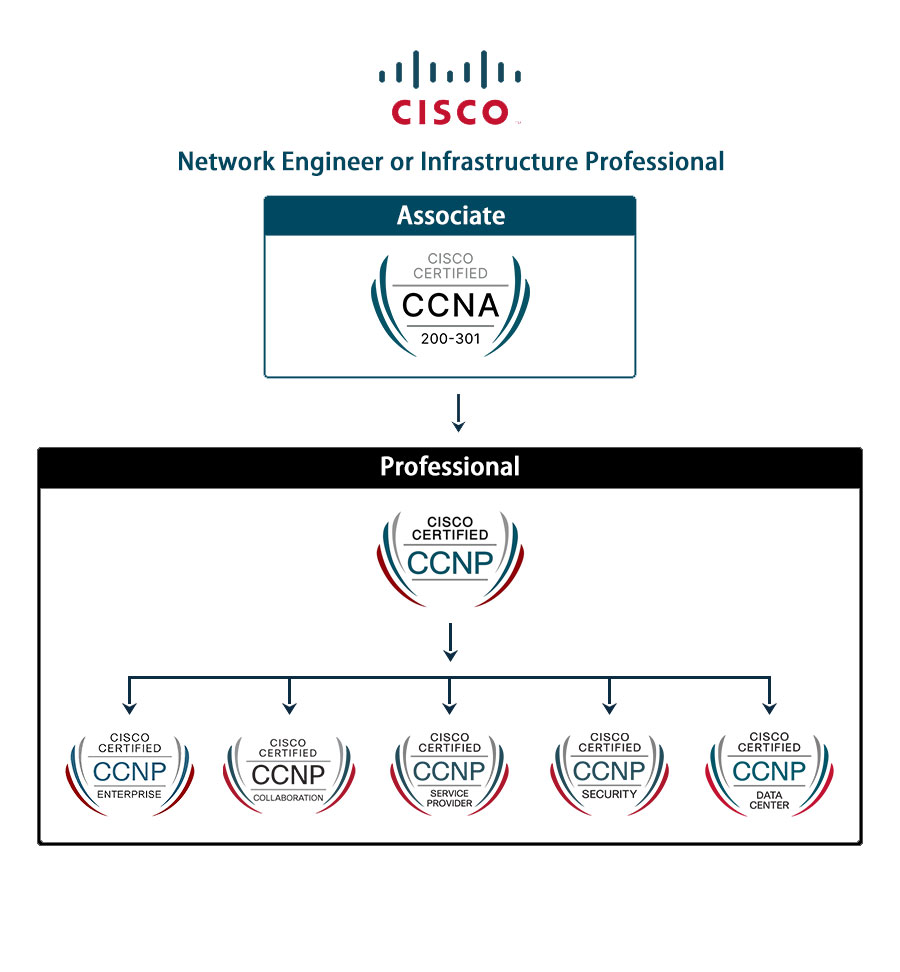
If You’re New to IT
CCNA is an excellent starting point, covering networking fundamentals, IP, and introductory automation, enabling quick entry into the workforce and experience building.
If Your Goal Is Cloud, Security, or AI

Cisco certifications provide a solid foundation but should be paired with specialized cloud or security certifications (e.g., AWS, Azure, or security-focused credentials) for complementary skills.
FAQs
Q1: How long does it take to prepare for Cisco certification?
Answer: The preparation time for Cisco certifications varies based on your background. For CCNA, 2–3 months is typically recommended.
For CCNP Routing and Switching, plan for 4–6 months. For CCIE, depending on lab experience, preparation may take 6 months to a year.
Q2: Is CCNA Alone Sufficient for the Job Market?
Answer: For entry-level networking roles, CCNA is often enough. However, to boost competitiveness or transition into areas like automation or security, pursuing CCNP or DevNet certifications is recommended.
Q3: Cisco vs. Cloud Certifications—Which Is Worth Investing In?
Answer: Each has its strengths. Networking fundamentals remain foundational for cloud and security roles. Combining Cisco certifications with cloud/security credentials (e.g., AWS, Azure) creates a differentiated,burgo System: competitive edge.
Q4: How Often Are Cisco Certifications Updated?
Answer: Cisco certifications are typically updated every 2–3 years, with newer tracks like DevNet and Security potentially seeing more frequent updates.
Q5: How to Choose the Right Certification Level?
Answer: Assess based on career goals, time, and budget. Start with CCNA for entry-level, or pursue CCNP or specialized tracks for skill advancement.
Q6: Are Cisco Certifications Cost-Effective?
Answer: Overall, the certification costs typically yield a return on investment within 1–2 years due to salary growth, making them a reliable choice in the industry.
Q7: What Reports and Links Are Available for Reference?
Answer: Refer to authoritative resources such as Global Knowledge reports, Pearson VUE certification insights, and Kentley Insights’ certification market forecasts.
Conclusion
Overall, “Is investing in Cisco certifications in 2025 still worthwhile?”—the answer is yes, especially for those pursuing networking careers or aiming to build a “networking + cloud” skillset. Its enduring brand value, industry recognition, and structured learning path keep it competitive in the job market for years to come. Consider your career goals and market trends when choosing the appropriate certification level.


Recent Comments