 Mike S Simon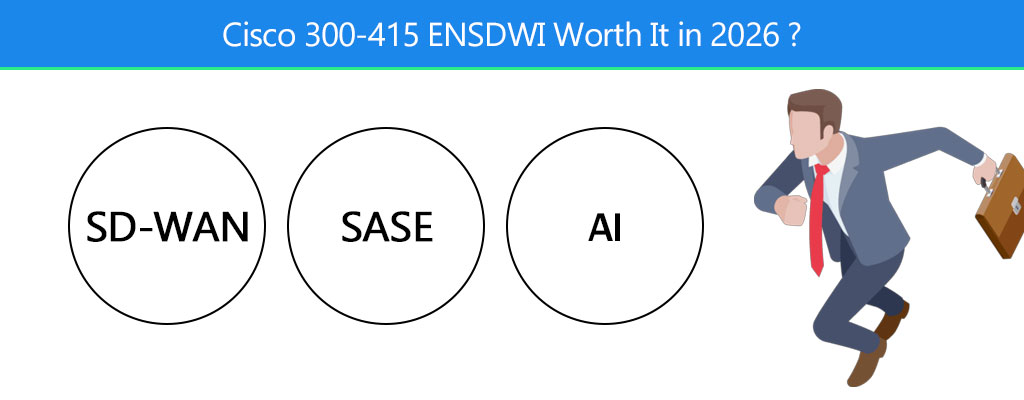
Many engineers assume SD-WAN is already yesterday’s technology. But large enterprises are still heavily investing in Cisco WAN modernization projects — just not in the same way they did five years ago. SD-WAN adoption is no longer about cutting-edge hype; it’s about solving real-world pain points in hybrid environments where cloud, security, and AI intersect. If you’re considering the Cisco 300-415 ENSDWI certification in 2026, it’s not enough to ask, “Is this certification worth it?” You also need to understand how enterprise network priorities, AI-driven management, and SASE adoption are reshaping both the technology and its value in the job market.
🌐 Why SD-WAN Is No Longer a “Future Technology”
The Shift From WAN to SD-WAN in Enterprises
In 2026, SD-WAN isn’t about imagining what might come next; it’s about how WAN modernization actually plays out in enterprises. While hype cycles have faded, large organizations are still moving away from MPLS-heavy architectures because of cost, flexibility, and cloud integration. SD-WAN has become a mature solution, particularly Cisco’s Catalyst SD-WAN, which integrates directly with cloud networking and security policies. In practice, engineers often find themselves managing hybrid WANs — where legacy MPLS coexists with internet broadband and private cloud links — rather than deploying SD-WAN in a greenfield environment.
Real-World Adoption Patterns
Reddit discussions and Cisco Live sessions reveal a key insight: adoption is patchy. Enterprises in regulated industries like finance and healthcare are slower to transition due to compliance and security concerns, whereas tech-heavy organizations prioritize cloud-first WAN designs. What many engineers don’t realize is that SD-WAN deployments today are less about technology experimentation and more about operational efficiency and policy enforcement across multiple sites. This is the reality that shapes whether ENSDWI is a meaningful certification: understanding deployment nuances often outweighs memorizing exam topics.
📉 Is Cisco SD-WAN Losing Momentum — or Just Evolving?
SASE and Competitor Pressure
The rise of SASE (Secure Access Service Edge) has caused some confusion. Competitors like Palo Alto, Fortinet, and Zscaler market SASE as the “replacement” for SD-WAN, which isn’t entirely accurate. Cisco itself has integrated SASE principles into its Catalyst SD-WAN offering. The technology is evolving, not disappearing. ENSDWI candidates often overlook this nuance: knowing SD-WAN fundamentals is still valuable, but understanding how Cisco’s architecture overlays security and cloud connectivity is what differentiates top engineers.
Cisco Catalyst SD-WAN Updates in 2026
Catalyst SD-WAN 22.x and later releases emphasize AI-assisted policy management, enhanced telemetry, and tighter integration with Cisco Umbrella for cloud security. From my experience consulting with enterprises, these features aren’t always exam-focused, but they heavily influence hiring decisions. Companies want engineers who can deploy SD-WAN in hybrid and cloud-centric environments while anticipating AI-driven automation impacts on traffic routing, policy enforcement, and troubleshooting.
🧠 What ENSDWI Actually Tests (Beyond the Blueprint)
Lab-Focused Skills
ENSDWI is deceptively practical. Beyond theory, the exam emphasizes configuring, monitoring, and troubleshooting SD-WAN policies under realistic scenarios. Many candidates underestimate the importance of lab practice. Cisco’s own labs can simulate enterprise-scale environments, but what separates a competent engineer from a top candidate is the ability to anticipate policy conflicts and application behavior in live networks.
Policy Design vs. Configuration
Passing ENSDWI isn’t just about memorizing CLI commands. Policy design understanding is critical. Reddit threads consistently show candidates struggle with policy-based routing, application-aware routing, and centralized vEdge templates. Real-world engineers must adapt policies to diverse WAN conditions — something that theory alone doesn’t prepare you for. Exam preparation should reflect this by emphasizing policy reasoning over rote memorization.
💼 Real Career Outlook for ENSDWI in 2026
Enterprise Hiring Trends
From my consulting experience, enterprises hiring for WAN modernization still value ENSDWI-certified engineers, but there’s a caveat: the role must align with hybrid or multi-cloud networking. Employers are looking for people who understand SD-WAN orchestration, telemetry, and integration with security frameworks like Zero Trust. ENSDWI alone won’t land a senior role; practical experience is essential.
MSP and Cloud Opportunities
Managed Service Providers (MSPs) increasingly require SD-WAN expertise, particularly for multi-tenant deployments. Certifications like ENSDWI signal that you’ve navigated real-world lab scenarios, which MSPs value. Cloud-focused engineers can leverage SD-WAN knowledge to design resilient hybrid architectures, especially when integrating AWS, Azure, or GCP with on-prem sites.
Candidate Pain Points
Community discussions highlight recurring frustrations: labs are time-intensive, policy design is abstract, and exam timing is tight. Many candidates feel unprepared despite passing theoretical assessments. Recognizing these pain points allows a candidate to focus preparation on realistic lab exercises, not just exam blueprints.
🔄 ENSDWI vs ENARSI vs DevNet: Different Career Paths
Choosing the Right Certification for Your Career Goals
ENSDWI fits engineers aiming for WAN transformation and hybrid network management. ENARSI leans more toward traditional routing and troubleshooting, whereas DevNet emphasizes automation and programmability. In practice, a career in enterprise WAN often requires a mix: ENSDWI for policy and deployment, DevNet for automation, and occasional ENARSI skills for legacy interoperability.
How Each Path Impacts Job Opportunities
Hiring managers differentiate candidates by demonstrated competence in hybrid environments. ENSDWI can open doors to WAN architect or SASE-focused roles, but combining it with automation credentials (DevNet) dramatically increases employability in 2026. Reddit posts confirm that hybrid skill sets consistently command higher salaries than single-track certifications.
☁️ How SASE and AI Networking Are Changing the Value of SD-WAN Skills
AI-Driven WAN Optimization
AI networking tools now proactively detect congestion, recommend routing changes, and predict outages. ENSDWI candidates who understand how AI influences policy decisions gain an edge. Employers increasingly value engineers who can combine SD-WAN expertise with AI monitoring platforms to reduce manual intervention and improve SLA adherence.
Integration of Zero Trust and SASE
SASE adoption doesn’t eliminate SD-WAN; it enhances its value. Engineers must understand how traffic is inspected, segmented, and tunneled across WAN links. ENSDWI teaches fundamental SD-WAN orchestration skills, but in practice, integrating Zero Trust and cloud-delivered security solutions is what drives real career impact.
🧪 Why Many Engineers Struggle With ENSDWI Labs
Lab Complexity and Realistic Scenarios
Many candidates underestimate the depth of labs. Enterprise environments feature overlapping policies, multiple transport types, and dynamic routing conditions. Simply memorizing topologies won’t help; success depends on troubleshooting, simulation, and hands-on adaptation.
Common Misconceptions About Testing Policy Knowledge
Reddit threads reveal a pattern: engineers often misjudge the exam as “CLI-focused.” Instead, ENSDWI evaluates policy reasoning and application awareness. Candidates who fail to internalize how routing decisions affect applications frequently stumble in labs, highlighting the gap between theory and applied knowledge.
📚 Best Ways to Prepare Without Memorization
Combining Cisco Labs with Community Insights
Practical preparation comes from repeated lab scenarios and community discussions. Reddit, Cisco Live sessions, and professional forums provide real-world problem-solving techniques that textbooks miss. Observing how experienced engineers approach policy conflicts, deployment pitfalls, and troubleshooting scenarios accelerates learning more than memorization alone.
Practical Resources Like Leads4Pass
Some engineers combine Cisco official labs with resources like Leads4Pass 300-415 to identify weak areas before the exam. The key isn’t rote learning; it’s recognizing patterns in policy design and troubleshooting so you can apply knowledge under pressure. This approach mirrors real-world deployment challenges, enhancing both exam success and career readiness.
🎯 Who Should Still Pursue ENSDWI in 2026?
Enterprise Engineers
If you manage multi-site WANs or are involved in cloud migration, ENSDWI remains relevant. The certification signals practical SD-WAN skills and policy orchestration understanding — exactly what enterprises need in complex hybrid networks.
MSP and Cloud-Focused Engineers
MSPs offering managed SD-WAN solutions benefit from ENSDWI-trained staff who can implement, monitor, and troubleshoot clients’ environments. Similarly, cloud-focused engineers integrating on-prem sites with cloud workloads find ENSDWI knowledge directly applicable.
Security-Focused Professionals
Security engineers integrating SASE or Zero Trust architectures will also find value. SD-WAN policy knowledge supports traffic segmentation, secure tunneling, and compliance — critical components for modern security strategies.
Final Thoughts
Cisco SD-WAN may no longer feel like the industry’s newest technology, but in large enterprise networking, mature technologies often survive far longer than social media trends suggest. ENSDWI still has value — just for a more specific kind of engineer than it did a few years ago. The certification is less about broad networking mastery and more about demonstrating hands-on experience, policy reasoning, and practical problem-solving in hybrid WAN environments. Candidates who focus on lab practice, community insights, and the evolving interplay between SD-WAN, SASE, and AI will gain real-world career advantages.
FAQs
Q1: Is ENSDWI still relevant with SASE becoming mainstream?
Yes. ENSDWI remains relevant for understanding SD-WAN orchestration, which underpins most SASE deployments in hybrid networks. It’s about applying SD-WAN knowledge within evolving security frameworks.
Q2: How does ENSDWI compare to DevNet for career advancement?
ENSDWI is ideal for WAN-focused roles, while DevNet emphasizes automation and programmability. Combining both can significantly enhance employability in hybrid and cloud-centric enterprises.
Q3: Do I need hands-on lab experience to pass ENSDWI?
Absolutely. Realistic lab scenarios are critical. Memorization alone is insufficient for passing labs and understanding policy design.
Q4: Which professionals benefit most from ENSDWI in 2026?
Enterprise engineers managing WANs, MSP engineers deploying SD-WAN solutions, cloud-focused engineers, and security professionals integrating SASE/Zero Trust will see the most value.
Q5: What’s the best way to prepare for ENSDWI without rote learning?
Focus on Cisco labs, real-world scenarios, Reddit discussions, and practical resources like Leads4Pass 300-415 to internalize policy behavior and troubleshooting patterns.

 Sharen C Soucie
Recent Comments