 exam
exam
200-301 Dumps Update, Real Cisco CCNA exam material to help you pass the exam with ease and prepare for advanced CCNP. Cisco 200-301 dumps questions are written by an experienced team and reviewed in real life. They are based on Network fundamentals, Network access, IP connectivity, IP services, Security fundamentals, Automation and programmability exam objectives to collect all valid questions and answers. leads4pass 200-301 dumps: https://www.leads4pass.com/200-301.html, Meeting all the conditions described above are guaranteed to pass the Cisco CCNA exam on your first attempt.
You can view the Cisco 200-301 free dumps demo online
QUESTION 1
Which mode must be used to configure EtherChannel between two switches without using a negotiation protocol?
A. active
B. on
C. auto
D. desirable
Correct Answer: B
The Static Persistence (or “on” mode) bundles the links unconditionally and no negotiation protocol is used. In this mode, neither PAgP nor LACP packets are sent or received.
QUESTION 2
What is the function of Opportunistic Wireless Encryption in an environment?
A. offer compression
B. increase security by using a WEP connection
C. provide authentication
D. protect traffic on open networks
Correct Answer: D
QUESTION 3
Which two commands can you use to configure an actively negotiate EtherChannel? (Choose two.)
A. channel-group 10 modes on
B. channel-group 10 mode auto
C. channel-group 10 modes passive
D. channel-group 10 mode desirable E. channel-group 10 mode active
Correct Answer: DE
QUESTION 4
DRAG-DROP
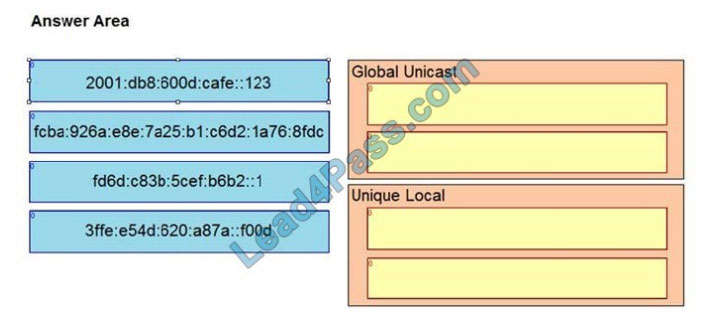
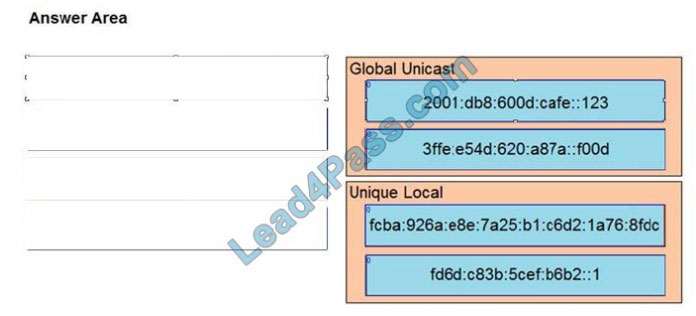
Drag and drop the IPv6 addresses from the left onto the corresponding address types on the right.
Select and Place:
Correct Answer:
QUESTION 5
Which level of severity must be set to get informational Syslogs?
A. alert
B. critical
C. notice
D. debug
Correct Answer: D
Specifying a level causes messages at that level and numerically lower levels to be displayed at the destination. From Table 3: informational level = 6, debugging level = 7, notice/notifications level = 5 Severity Level 7 – Making
informational, notice, Warning, Error, Critical, Alert, Emergency appear in the Syslog
https://www.cisco.com/c/en/us/td/docs/routers/access/wireless/software/guide/SysMsgLogging.html
QUESTION 6
Which protocol is used for secure remote CLI access?
A. Telnet
B. HTTP
C. HTTPS
D. SSH
Correct Answer: D
QUESTION 7
What is the function of the controller in a software-defined network?
A. multicast replication at the hardware level
B. fragmenting and reassembling packets
C. making routing decisions
D. forwarding packets
Correct Answer: C
QUESTION 8
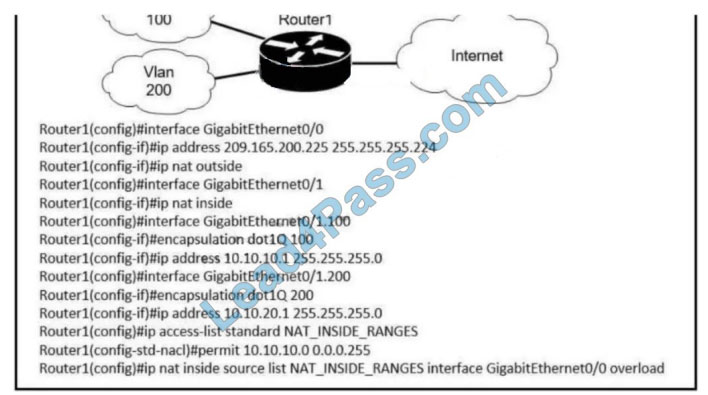
Refer to the exhibit. Users on existing VLAN 100 can reach sites on the Internet. Which action must the administrator
take to establish connectivity to the Internet for users in VLAN 200?
A. Define a NAT pool on the router.
B. Configure static NAT translations for VLAN 200.
C. Configure the IP nat outside command on another interface for VLAN 200.
D. Update the NAT_INSIDE_RANGES ACL
Correct Answer: D
QUESTION 9
What prevents a workstation from receiving a DHCP address?
A. DTP
B. STP
C. VTP
D. 802.10
Correct Answer: B
QUESTION 10
What is the function of the Wireless LAN Controller?
A. register with a single access point that controls traffic between wired and wireless endpoints.
B. use SSIDs to distinguish between wireless clients.
C. send LWAPP packets to access points.
D. monitor activity on wireless and wired LANs
Correct Answer: C
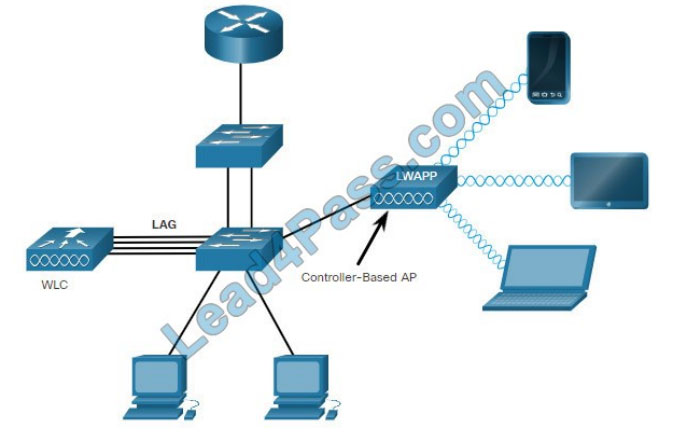
Lightweight APs (LAPs) are devices that require no initial configuration. LAPs use the Lightweight Access Point Protocol (LWAPP) to communicate with a WLAN controller (WLC), as shown in the below figure. Controller-based APs are useful in situations where many APs are required in the network. As more APs are added, each AP is automatically configured and managed by the WLC.
QUESTION 11
When a client and server are not on the same physical network, which device is used to forward requests and replies
between client and server for DHCP?
A. DHCP relay agent
B. DHCP server
C. DHCPDISCOVER
D. DHCPOFFER
Correct Answer: A
QUESTION 12
Which IPv6 addresses type communication between subnets and cannot route on the Internet?
A. link-local
B. unique local
C. multicast
D. global unicast
Correct Answer: B
A IPv6 Unique Local Address is an IPv6 address in the block FC00::/7. It is the approximate IPv6 counterpart of the IPv4 private address. It is not routable on the global Internet.
Note: In the past, Site-local addresses (FEC0::/10) are equivalent to private IP addresses in IPv4 but now they are
deprecated.
Link-local addresses are only used for communications within the local subnet. It is usually created dynamically using a link-the local prefix of FE80::/10 and a 64-bit interface identifier (based on a 48-bit MAC address).
QUESTION 13
Which CRUD operation modifies an existing table or view?
A. read
B. create
C. replace
D. update
Correct Answer: D
……
Cisco 200-301 Free Dumps Demo Online Download:https://drive.google.com/file/d/1Kw3N92XaJXXCGnVMDGdTr3iCPn_5Nb0D/view?usp=sharing
Now, for real Cisco CCNA exam material, use the 200-301 dumps:https://www.leads4pass.com/200-301.html. Helping you pass the exam on your first attempt.

Recent Comments