 exam
examCCNP Data Center 300-630 Dumps is the Cisco 300-630 DCACIA exam material for launching your career in Application Centric Infrastructure – Advanced.
leads4pass 300-630 Dumps Prepares Candidates for Cisco DCACIA Exam Questions and Answers
https://www.leads4pass.com/300-630.html helps you earn the Cisco CCNP Data Center Exam Certification.
Cisco technology is spread all over the world. This means that CCNP Data Center-certified professionals will continue to be sought after, as long as you ensure that you can successfully achieve the CCNP Data Center 300-630 certification. Use the CCNP Data Center 300-630 dumps to guarantee your success with the Cisco CCNP Data Center exam certification.
CCNP Data Center exam FAQs: About, Value, Exam Material
About 300-630 DCACIA: What You Need to Know
Vendor: Cisco
Exam Code: 300-630
Exam Name: Implementing Cisco Application Centric Infrastructure – Advanced (DCACIA)
Certification: CCNP Data Center
Languages: English
Price: $300 USD
Duration: 90 mins
Number of Questions: 55-65 questions
Passing score: 80% Approx
300-630 dumps: https://www.leads4pass.com/300-630.html (CCNP Data Center exam dumps maps to Cisco 300-630 DCACIA exam objectives)
300-630 dumps (Number of Questions): 76 Q&A
Is CCNP Data Center certification worth it?
The CCNP Data Center is definitely worth it. Whether you work with data centers directly or indirectly, the CCNP Data Center is simply one of the best possible ways to learn the tools, hardware and software, and technologies that make them possible.
–source: https://www.cbtnuggets.com/blog/certifications/cisco/is-the-ccnp-data-center-worth-it
Free share of a portion of the CCNP Data Center 300-630 DCACIA exam material
| Number of exam questions | Exam name | From | Previous issue |
| 15 | Implementing Cisco Application Centric Infrastructure – Advanced (DCACIA) | leads4pass | 300-630 exam questions q1-q15 |
New Question 16:
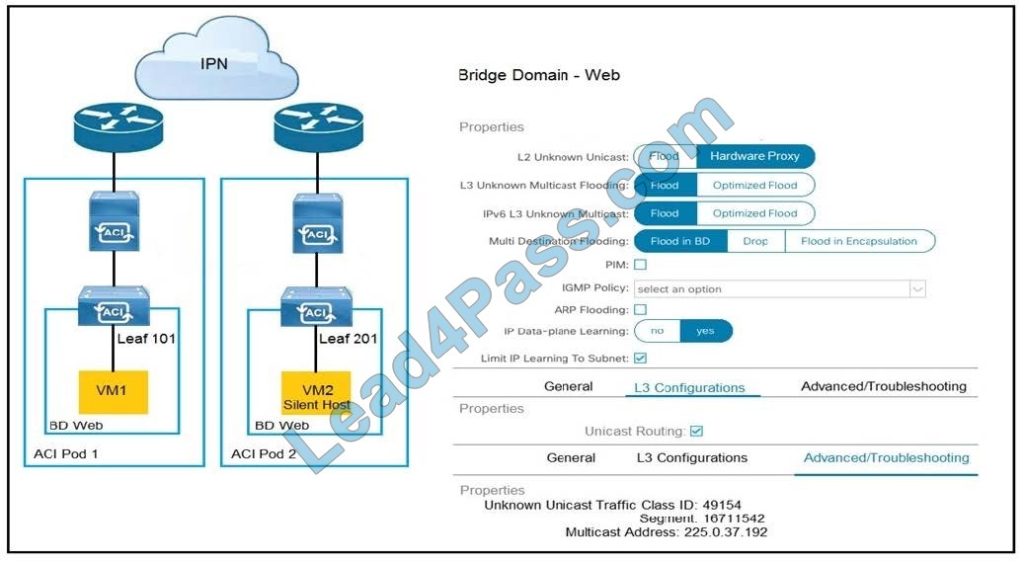
Refer to the exhibit. How is the ARP request from VM1 forwarded when VM2 is not learned in the Cisco ACI fabric?
A. Leaf 101 forwards the ARP request to one of the proxy VTEP spines.
B. POD1 spine responds to the ARP request after the POD1 COOP is updated with the VM2 location.
C. Leaf 101 encapsulates the ARP request into a multicast packet that is destined to 225.0.37.192.
D. Leaf 101 switch consumes the ARP reply of VM2 to update the local endpoint table.
Correct Answer: A
New Question 17:
What does the VXLAN source port add to the overlay packet forwarding when it uses the hash of Layer 2, Layer 3, and Layer 4 headers of the inner packet?
A. ECMP
B. TCP optimization
C. disabled fragmentation
D. jumbo frames
Correct Answer: A
New Question 18:
Which two actions are the Cisco best practices to configure NIC teaming load balancing for Cisco UCS B-Series blades that are connected to the Cisco ACI leaf switches? (Choose two.)
A. Create vPC+
B. Enable LACP active mode
C. Create PAgP
D. Create vPC
E. Enable MAC pinning
Correct Answer: BE
New Question 19:
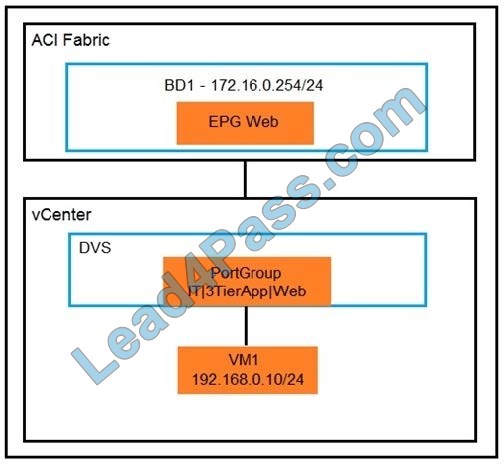
An organization migrates its virtualized servers from a legacy environment to Cisco ACI. VM1 is incorrectly attached to PortGroup IT|3TierApp|Web. Which action limits IP address learning in BD1?
A. Enable Enforce Subnet Check
B. Enable Rouge Endpoint Control
C. Enable GARP-based EP Move Detection Mode
D. Disable Remote EP Learn
Correct Answer: C
New Question 20:
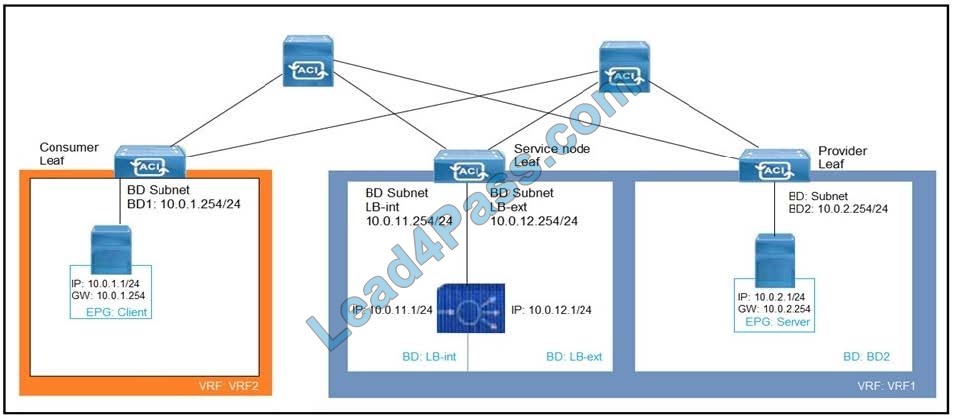
Refer to the exhibit. What must be configured to allow the PBR node (LB-int) to monitor the availability of the endpoint that is in the EPG server?
A. Endpoint Dataplane Learning
B. Unicast Route disabled for client and server bridge domains
C. PBR node tracking
D. Direct Connect in the service graph template
Correct Answer: A
New Question 21:
An engineer must limit local and remote endpoint learning to the bridge domain subnet. Which action should be taken inside the Cisco APIC?
A. Disable Remote EP Learn
B. Enable Enforce Subnet Check
C. Disable Endpoint Dataplane Learning
D. Enable Limit IP Learning to Subnet
Correct Answer: B
New Question 22:
What is the purpose of the Forwarding Tag (FTAG) in Cisco ACI?
A. FTAG is used in Cisco ACI to add a label to the iVXLAN traffic in the fabric to apply the correct policy.
B. FTAG is used in Cisco ACI to add a label to the VXLAN traffic in the fabric to apply the correct policy.
C. FTAG trees in Cisco ACI are used to load balance unicast traffic.
D. FTAG trees in Cisco ACI are used to load balance mutli-destination traffic.
Correct Answer: D
New Question 23:
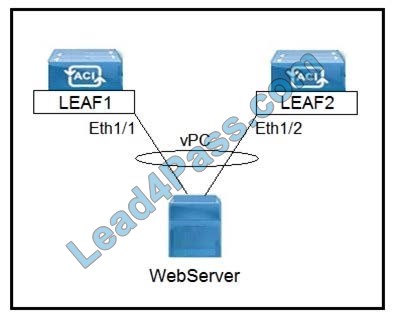
Refer to the exhibit. Which three actions should be taken to implement the vPC in the Cisco ACI fabric? (Choose three.)
A. Select a common PC interface policy group
B. Select individual interface profiles
C. Select common interface profiles
D. Select individual switch profiles
E. Select common switch profiles
Correct Answer: ABE
New Question 24:
Which action should be taken in Cisco ACI to reassign a unique globally scoped pcTag to an EPG that provides a global contract?
A. Configure subnets that are treated as virtual IP
B. Configure subnets that advertise externally
C. Configure subnets that are shared between VRFs
D. Configure subnets that are private to VRF
Correct Answer: C
New Question 25:
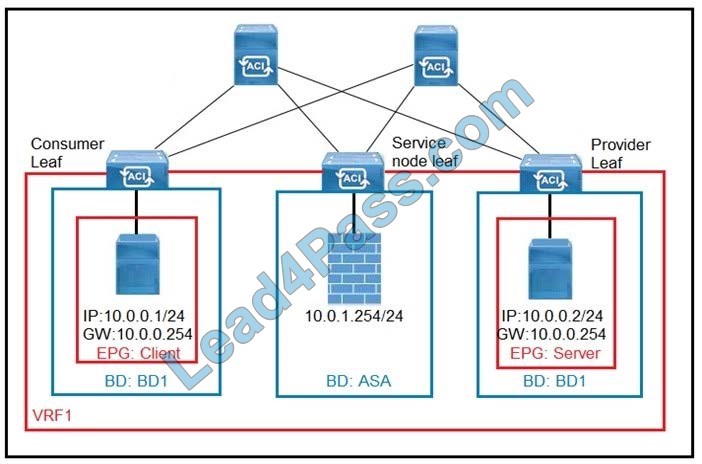
Refer to the exhibit. What must be configured in the service graph to redirect HTTP traffic between the EPG client and EPG server to go through the Cisco ASA firewall?
A. contract filter to allow ARP and HTTP
B. precise filter to allow only HTTP traffic
C. contract with no filter
D. permit-all contract filter
Correct Answer: A
New Question 26:
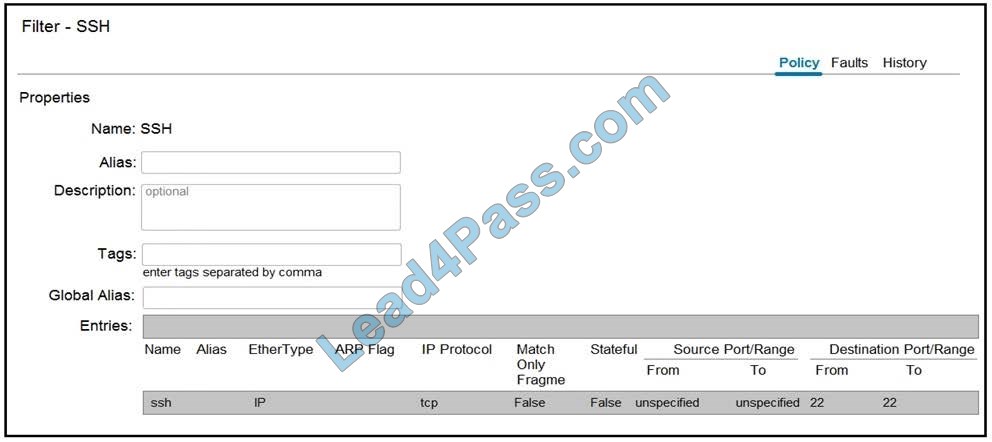
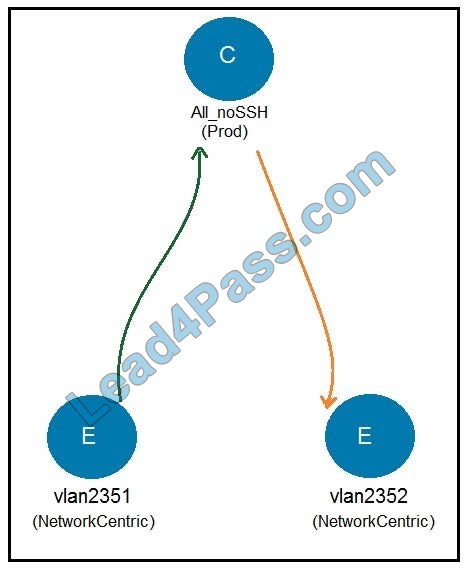
Refer to the exhibits. Which subject must be configured for the All_noSSH contract to allow all IP traffic except SSH between the two EPGs?
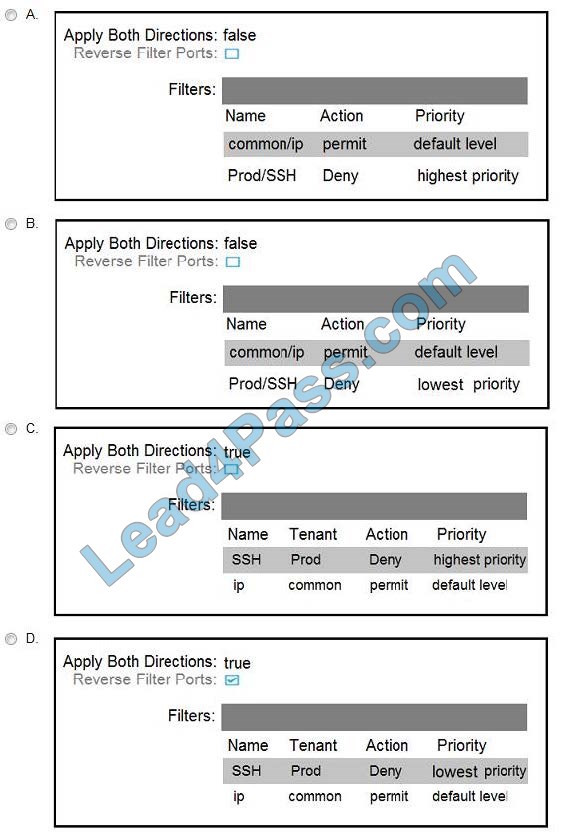
A. Option A
B. Option B
C. Option C
D. Option D
Correct Answer: D
New Question 27:
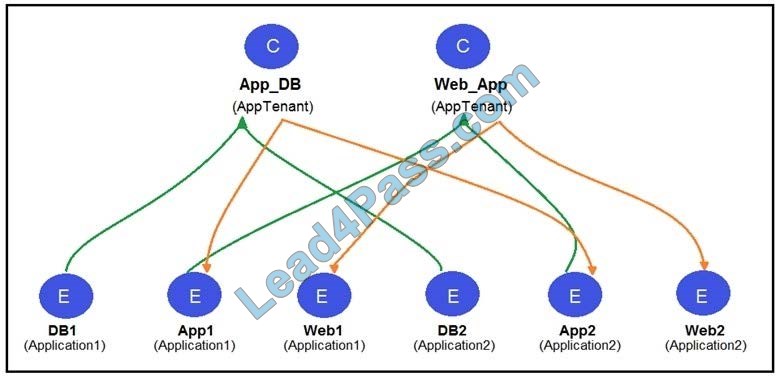
Refer to the exhibit. Two application profiles are configured in the same tenant and different VRFs. Which contract scope is configured to allow communication between the two application profiles?
A. global
B. VRF
C. application
D. tenant
Correct Answer: D
New Question 28:
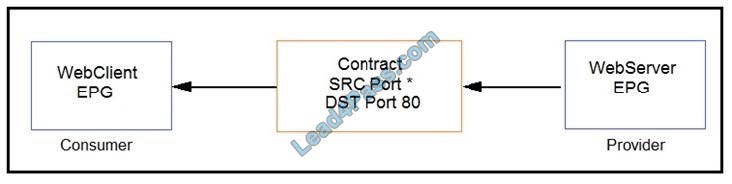
Refer to the exhibit. Which combination of flags in the Cisco ACI contract allows a client in WebClient EPG to establish an HTTP connection toward a server in WebServer EPG?
A. Apply Both Direction ENABLED and Reverse Port Filter ENABLED
B. Apply Both Direction DISABLED and Reverse Port Filter DISABLED
C. Apply Both Direction DISABLED and Reverse Port Filter ENABLED
D. Apply Both Direction ENABLED and Reverse Port Filter DISABLED
Correct Answer: C
New Question 29:
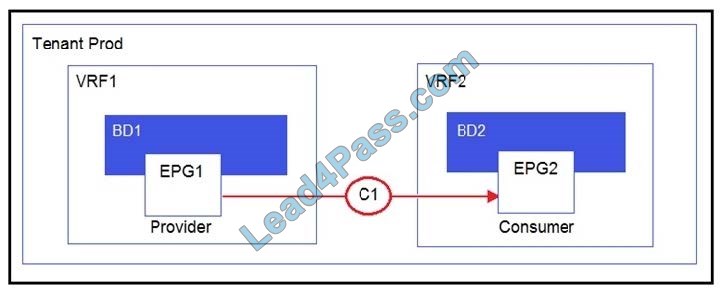
Refer to the exhibit. Which two configurations enable inter-VRF communication? (Choose two.)
A. Set the subnet scope to Shared Between VRFs
B. Enable Advertise Externally under the subnet scope
C. Change the contract scope to Tenant
D. Change the subject scope to VRF
E. Export the contract and import as a contract interface
Correct Answer: BE
New Question 30:
Which two actions should be taken to ensure a scalable solution when multiple EPGs in a VRF require unrestricted communication? (Choose two.)
A. Configure a taboo contract between the EPGs that require unrestricted communication between each other.
B. Enable Preferred Group Member under the EPG Collection for the VRF section.
C. Set the VRF policy control enforcement preference to Unenforced.
D. Set the EPGs that require unrestricted communication between each other as preferred group members.
E. Set the EPGs that require policy enforcement between each other as preferred group members.
Correct Answer: CD
[Free Download] CCNP Data Center 300-630 DCACIA exam material:
https://drive.google.com/file/d/1o3cRFoyGbbdV7ptLRokMcFP_9638QVTy/
The above are free to share 15 300-630 DCACIA exam material, click here to get more exam questions and answers.


Recent Comments