 exam
examCisco 100-105 ICND1 v3.0 exam for the CCENT and CCNA certifications, Pass your Cisco Interconnecting Cisco 100-105 dumps exam Networking Devices Part 1 (ICND1 v3.0) exam. Practice test for 100-105 exam with real exam questions and answers.
QUESTION 1
A receiving host has failed to receive all of the segments that it should acknowledge. What can the host do to improve the reliability of this communication session?
A. decrease the window size
B. use a different source port for the session
C. decrease the sequence number
D. obtain a new IP address from the DHCP server
E. start a new session using UDP
Correct Answer: A
QUESTION 2
Why would a network administrator configure port security on a switch?
A. to prevent unauthorized Telnet access to a switch port
B. to prevent unauthorized hosts from accessing the LAN
C. to limit the number of Layer 2 broadcasts on a particular switch port
D. block unauthorized access to the switch management interfaces
Correct Answer: B
QUESTION 3
Refer to the exhibit.
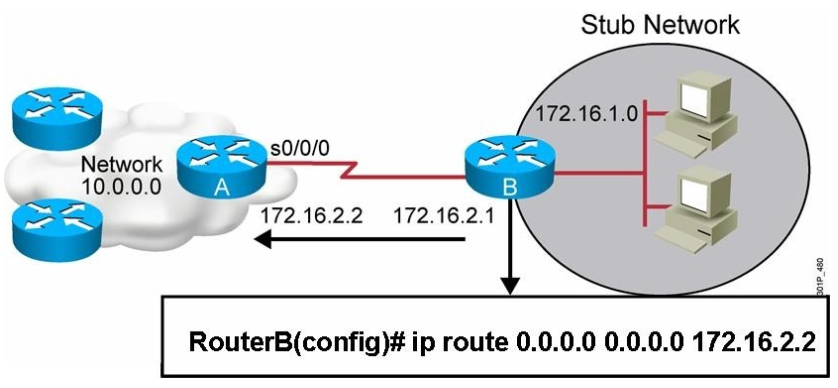
Which two statements are correct? (Choose two.) 100-105
A. This is a default route.
B. Adding the subnet mask is optional for the ip route command.
C. This will allow any host on the 172.16.1.0 network to reach all known destinations beyond RouterA.
D. This command is incorrect, it needs to specify the interface, such as s0/0/0 rather than an IP address.
E. The same command needs to be entered on RouterA so that hosts on the 172.16.1.0 network can reach network 10.0.0.0.
Correct Answer: AC
QUESTION 4
The ip helper-address command does what?
A. assigns an IP address to a host
B. resolves an IP address from a DNS server
C. relays a DHCP request across networks
D. resolves an IP address overlapping issue
Correct Answer: C
QUESTION 5
Refer to the exhibit.
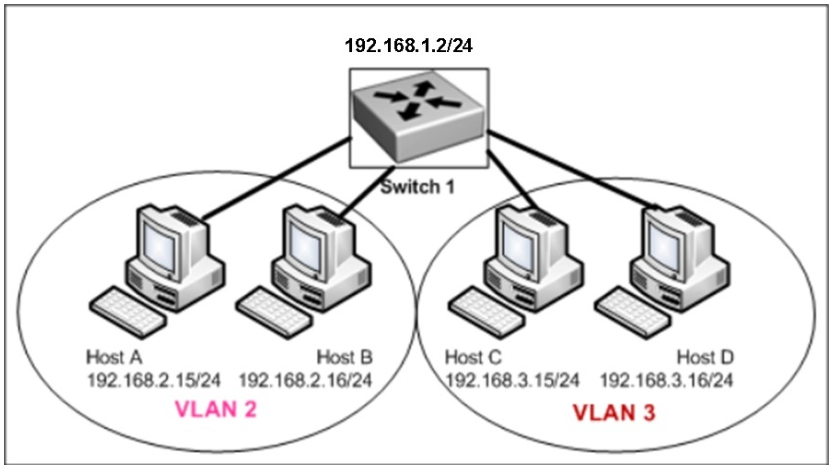
Host A can communicate with Host B but not with Hosts C or D. 100-105 How can the network administrator solve this problem?
A. Configure Hosts C and D with IP addresses in the 192.168.2.0 network.
B. Install a router and configure a route to route between VLANs 2 and 3.
C. Install a second switch and put Hosts C and D on that switch while Hosts A and B remain on the original switch.
D. Enable the VLAN trunking protocol on the switch.
Correct Answer: B
QUESTION 6
Which destination IP address can a host use to send one message to multiple devices across different subnets?
A. 172.20.1.0
B. 127.0.0.1
C. 192.168.0.119
D. 239.255.0.1
Correct Answer: D
QUESTION 7
Which method does a connected trunk port use to tag VLAN traffic?
A. IEEE 802 1w
B. IEEE 802 1D
C. IEEE 802 1Q
D. IEEE 802 1p
Correct Answer: C
QUESTION 8
What is one requirement for interfaces to run IPv6?
A. An IPv6 address must be configured on the interface.
B. An IPv4 address must be configured.
C. Stateless autoconfiguration must be enabled after enabling IPv6 on the interface.
D. IPv6 must be enabled with the ipv6 enable command in global configuration mode.
Correct Answer: A
The best Cisco 100-105 dumps exam ICND1 is the industry leader in information technology, and getting certified by them is a guaranteed way to succeed with IT careers. We help you do exactly that with our high quality Cisco ICND1 100-105 dumps exam training materials.
Watch the video to learn more:
https://youtu.be/trVHfqmuVvg

 Kyle Bray
Recent Comments