 Kyle Bray
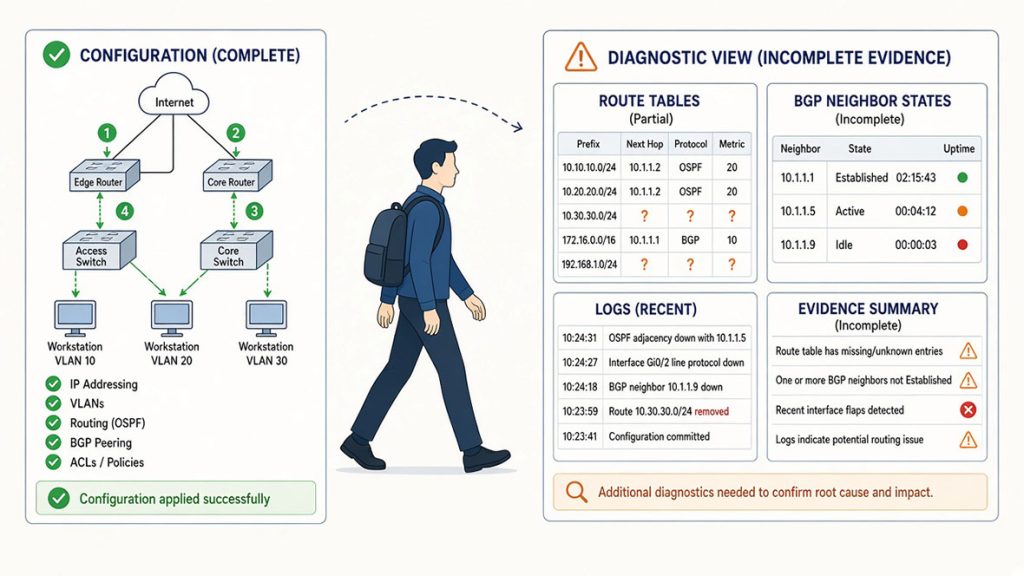
There is a familiar pattern in Cisco 300-410 ENARSI preparation. A candidate builds the topology, gets OSPF neighbors up, establishes BGP sessions, works through DMVPN, and eventually reaches the point where the lab looks clean. That feels like progress, and it is. But there is a difference between making a network work and understanding why a partially broken network does not work. That difference is where preparation starts becoming much more demanding.
If I were preparing for ENARSI today, I would spend less time asking whether I had completed another lab and more time asking what the lab could teach me when something went wrong.
If you’re building your preparation around third-party practice material, Leads4Pass 300-410 can be treated as one optional practice layer for identifying areas that still need work. Leads4Pass 300-410 It should not replace Cisco’s official blueprint, technical documentation, or hands-on troubleshooting.
The Official Picture Has Not Dramatically Changed
What Cisco Actually Says About ENARSI v1.1
As of August 14, 2026, Cisco’s official exam page still identifies 300-410 ENARSI v1.1 as a 90-minute exam focused on implementing and troubleshooting advanced routing technologies and services. Cisco specifically identifies Layer 3, VPN services, infrastructure security, infrastructure services, and infrastructure automation within the exam description. The exam can serve as the concentration exam for CCNP Enterprise, while also earning the Cisco Certified Specialist – Enterprise Advanced Infrastructure Implementation credential.
The current official topic document gives the weighting a useful shape: Layer 3 Technologies 35%, VPN Technologies 20%, Infrastructure Security 20%, and Infrastructure Services 25%. That distribution matters because it tells us something beyond which technologies appear. A large portion of the blueprint is explicitly written around troubleshooting. The Layer 3 section, for example, includes troubleshooting administrative distance, route maps, redistribution, summarization, EIGRP, OSPF, and BGP. Infrastructure Services also uses troubleshooting language across device management, SNMP, logging, DHCP, IP SLA, NetFlow, and Catalyst Center Assurance.
What Has Not Been Verified in 2026
There is no current Cisco evidence supporting a dramatic July or August 2026 blueprint overhaul. The safer interpretation is therefore also the more useful one: ENARSI is not suddenly a different exam simply because preparation discussions online have changed.
That distinction matters because unofficial topic lists and candidate recollections can create a strange feedback loop. Someone sees a new discussion, assumes the exam has changed, adjusts the study plan, and then spends time chasing material that Cisco’s published blueprint does not emphasize. Cisco itself describes the exam topics as general guidelines and says they may change without notice, so checking the official source remains the sensible way to establish the current scope.
The more interesting 2026 story is not a mysterious blueprint change. It is the growing evidence that knowing the technology and diagnosing the technology are different skills.
The Preparation Gap Is Between Configuration and Diagnosis
Configuration Is Only the First Layer of Practice
A clean lab gives you a favorable environment. You know the objective, you know the topology, and you usually know which technology is being tested. That makes configuration practice useful, but it also makes the problem artificially tidy.
Consider OSPF. Establishing an adjacency proves that you can configure the relationship. Verifying the neighbor state proves that you can confirm the relationship exists. But an ENARSI-style troubleshooting problem can move one step sideways: the adjacency appears healthy, yet the expected route is not installed.
That is a different question.
| Practice level | What you are actually proving |
| Configuration | You can establish an OSPF adjacency |
| Verification | You can confirm the neighbor and route state |
| Troubleshooting | You can determine why the expected route is absent despite an apparently healthy adjacency |
The distinction sounds subtle until the evidence becomes incomplete. Then it becomes the entire problem.
Troubleshooting Requires Evidence, Not Familiarity
Troubleshooting begins when the obvious answer is no longer enough. You have to decide which relationship matters, which output is relevant, and which explanation can be eliminated before touching the configuration.
That is why a candidate can be technically strong and still feel uncomfortable with an advanced routing scenario. Technical familiarity tells you what could be wrong. Troubleshooting judgment helps you determine what is wrong from the evidence available.
The current ENARSI blueprint reflects that distinction unusually clearly. BGP includes neighbor relationships, path preference, route reflectors, and inbound/outbound policy troubleshooting. OSPF covers relationships, network and area types, router roles, virtual links, and path preference. EIGRP includes neighbor behavior, feasible paths, metrics, stubs, and load balancing.
The preparation question therefore changes from “Have I covered BGP?” to something much narrower and more useful: Can I look at BGP evidence and explain why the expected path is not winning?
What Recent Candidate Experiences Reveal
The May 2026 Experience
A May 23, 2026 Reddit discussion offers a useful example, not because one candidate’s experience defines the exam, but because it illustrates the preparation gap described above.
One candidate reported having practiced the labs extensively, including DMVPN with IPsec and EIGRP authentication with VRF, yet said the multiple-choice portion caused difficulty because several configurations appeared similar and the challenge was identifying which command actually addressed the problem. Another participant in the same discussion said they had failed twice and passed on the third attempt.
That is anecdotal evidence. It cannot tell us what Cisco’s entire exam looks like, and it certainly should not be used to reconstruct exam questions. But the underlying observation is worth taking seriously: a candidate can feel very comfortable inside a lab and still struggle when the task becomes interpretation rather than construction.
A separate May 2026 discussion contains another useful contrast. One candidate described failing ENARSI after months of preparation and said the labs felt significantly harder than the practice environments they had used. Another candidate who passed on a third attempt described creating different topologies around blueprint objectives marked for configuration or troubleshooting.
The evidence is not consistent enough to produce a formula. It does, however, point toward a preparation style that is harder to fake: deliberately breaking the environment and then explaining the evidence.
Why a Third Attempt Can Change the Preparation Strategy
A failed attempt does not automatically reveal the correct study plan. What it can reveal is the difference between what you expected to be tested and what you were actually prepared to reason through.
That distinction is valuable even without knowing any exam-specific details.
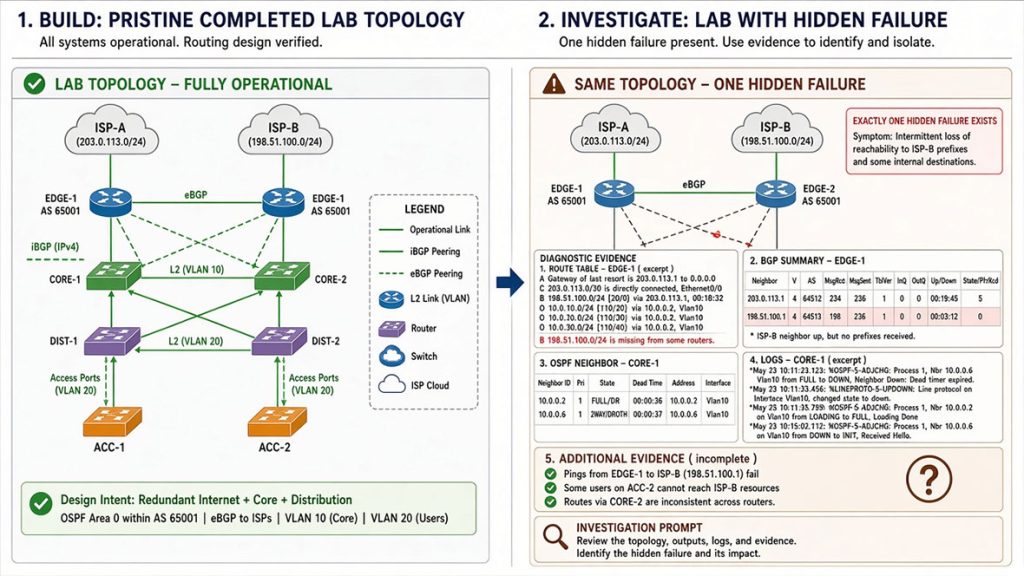
If your lab routine always ends with a successful ping, a full routing table, or an established tunnel, you may be training yourself to recognize completion rather than failure. The better exercise is sometimes to stop before the network is fixed. Leave the broken relationship in place. Record the output. State the hypothesis. Then decide what evidence would confirm or reject it.
That turns the lab from a configuration exercise into an investigation.
Where the Gap Becomes Visible
BGP and OSPF Expose Reasoning Problems
BGP is a good example because a healthy neighbor relationship does not automatically mean the desired route will be selected. The current blueprint specifically includes path preference, best-path behavior, policies, filtering, route reflectors, and neighbor-related details.
OSPF creates a similar distinction. An adjacency can be present while the route outcome is still unexpected. Network type, area type, router role, path preference, and route information all interact. A candidate who has only practiced establishing neighbors may recognize the symptom without having enough diagnostic structure to explain the cause.
The useful practice is not another perfect topology. It is a topology where one variable has been deliberately altered and the engineer has to determine which layer of the routing decision changed.
DMVPN and VRF Add Interactions
DMVPN makes the same point from another direction. Cisco’s blueprint includes GRE/mGRE, NHRP, IPsec, dynamic neighbors, and spoke-to-spoke behavior.
Those components do not exist in isolation. A routing problem may look like a tunnel problem. A tunnel can exist while the routing relationship is wrong. A security relationship can be established while the expected traffic behavior remains broken.
VRF-Lite introduces another layer because the question is no longer simply whether a route exists. It becomes whether the route exists in the relevant routing context and whether the surrounding relationships are operating within that context.
This is exactly where clean configuration practice can become misleading. When every component is introduced in the intended order, the interaction seems obvious. When one component is already wrong, the engineer has to reconstruct that logic from evidence.
Infrastructure Services Deserve More Attention
The 25% allocation to Infrastructure Services deserves more attention than it usually receives in routing-heavy study plans. Cisco’s current blueprint includes troubleshooting device management, SNMP, logging, DHCP, IP SLA, NetFlow, and Catalyst Center Assurance.
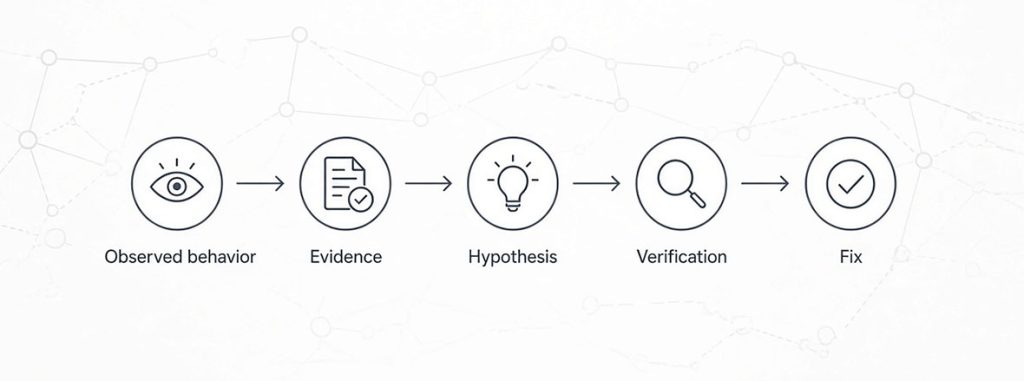
These subjects can feel less satisfying to lab because they do not always produce the same visual reward as establishing an OSPF neighbor or bringing up a BGP session. Yet diagnosis in these areas still depends on the same habit: identify the symptom, establish what should be happening, inspect the evidence, and isolate the failing relationship.
The point is not to spend equal time on every topic. It is to avoid allowing routing familiarity to create a blind spot around services that occupy a quarter of the published blueprint.
A Better Way to Practice ENARSI
Turn Clean Labs Into Broken Networks
The easiest adjustment is also one of the most useful: stop resetting every lab to a perfect state immediately after finishing it.
Take a working topology and change one thing. Alter a routing policy. Introduce an incorrect metric. Remove a required relationship. Change the context in which a route is expected. Disrupt a service dependency. Then hide the modification from yourself.
Now work from the outputs.
The goal is not to create artificial difficulty for its own sake. The goal is to practice the mental transition from “I know what this command does” to “I can determine why this network is behaving this way.”
That distinction also makes practice questions more useful. Instead of simply checking whether your answer is correct, explain why each plausible alternative is wrong. If you cannot explain the alternatives, the question has probably exposed a knowledge gap that deserves another lab.
Explain the Evidence Before Changing Anything
One habit I would deliberately build into ENARSI preparation is a short pause before configuration changes.
When something fails, state the evidence first.
The neighbor is established, but the route is absent.
The tunnel is present, but the expected path is unavailable.
The service responds locally, but the remote behavior is inconsistent.
The route exists, but it is not the selected path.
Those observations narrow the problem. They also prevent the classic lab reflex of changing three commands at once and then celebrating when the result happens to improve.
Cisco’s own training guidance emphasizes hands-on labs and assessments as part of preparation, which supports the practical side of this approach.
A Practical Readiness Test
Near the end of preparation, I would stop measuring readiness by how quickly a familiar lab can be configured.
Instead, give yourself unfamiliar failure states and see how you respond.
Can you explain why a route is absent without immediately changing the configuration?
Can you distinguish an adjacency problem from a route-installation or path-selection problem?
Can you work from command output without knowing beforehand which technology is responsible?
Can you identify the next diagnostic command because of the evidence, rather than because it is the command you usually run?
Can you explain why one plausible fix is better than another?
If those situations still feel uncomfortable, that does not necessarily mean you need another course. It may mean your practice environment is giving you too much information and too little uncertainty.
That is a useful distinction to discover before exam day.
Conclusion
The Cisco 300-410 ENARSI story in 2026 is not about chasing an unverified new blueprint. Cisco’s current material still presents ENARSI v1.1 as an advanced implementation and troubleshooting exam, with a blueprint that places substantial weight on diagnosing routing, VPN, security, and infrastructure-service behavior.
The preparation problem is more subtle.
A working configuration proves that you can build something. A verification exercise proves that you can recognize its state. Troubleshooting asks whether you can reconstruct the cause when the evidence is incomplete and several explanations remain plausible.
That is the skill worth developing.
If I were preparing for ENARSI now, I would still build the labs, still work through the official topics, and still use practice questions. But I would deliberately spend part of that time breaking what I had already built.
The strongest sign of readiness is not that the network works when you expect it to.
It is that you can explain what is wrong when it doesn’t.
FAQs
1. Has Cisco changed the 300-410 ENARSI exam in August 2026?
Cisco’s current official exam page identifies 300-410 ENARSI v1.1. There is no verified July or August 2026 announcement in the official sources reviewed for this article indicating a major blueprint replacement or retirement.
2. What are the current ENARSI exam topic weightings?
The current Cisco exam-topic document lists Layer 3 Technologies at 35%, VPN Technologies at 20%, Infrastructure Security at 20%, and Infrastructure Services at 25%. The document also states that the topics are general guidelines and may change without notice.
3. Is lab practice enough for ENARSI preparation?
Hands-on practice is highly relevant, but a clean configuration lab does not necessarily test the same reasoning as a troubleshooting scenario. A stronger preparation routine combines configuration, verification, deliberate failure injection, evidence analysis, and explanation of alternative causes.
4. Should Infrastructure Services be part of an ENARSI study plan?
Yes. Infrastructure Services represents 25% of the published blueprint, covering areas including device management, SNMP, logging, DHCP, IP SLA, NetFlow, and Catalyst Center Assurance. Treating these subjects as secondary simply because routing feels more central can create an avoidable preparation gap.
5. Is ENARSI part of the CCNP Enterprise certification path?
Yes. Cisco identifies ENARSI as a concentration exam associated with CCNP Enterprise. Candidates earn the specialist credential for passing ENARSI, and the exam can satisfy the concentration requirement when combined with the required core exam.

 exam
exam
Recent Comments