 Kyle Bray
Cisco 350-401 ENCOR is not hard because Cisco added more technologies. It is hard because it asks engineers to think differently.
The ENCOR Problem Is Not Difficulty — It Is The Change In Engineering Mindset
The biggest adjustment when moving toward Cisco 350-401 ENCOR is not learning another set of commands. The real change is moving away from the mindset of “I know how to configure this feature” and toward “I understand why this design exists, what problem it solves, and how different systems interact.” This is the point where many engineers realize that enterprise networking is less about individual technologies and more about making decisions inside complex environments.
A CCNA-level approach often focuses on understanding concepts, memorizing protocols, and building confidence with device configuration. Those skills remain valuable, but ENCOR expects a broader perspective. Enterprise engineers rarely work with isolated routers and switches. They deal with business requirements, application performance, security policies, cloud connectivity, automation systems, and operational visibility. A network change is no longer just a configuration task. It becomes a decision that can affect hundreds or thousands of users.
The difference looks simple on paper, but it changes how you prepare:
| Earlier Networking Learning | Enterprise Engineering Thinking |
|---|---|
| Knowing commands | Understanding technical decisions |
| Configuring devices | Designing reliable solutions |
| Following examples | Troubleshooting unknown situations |
| Learning protocols separately | Understanding system relationships |
This explains why some candidates spend months preparing but still feel uncomfortable before the exam. They may know OSPF commands, VLAN concepts, or wireless terminology, but they struggle when a question combines several technologies and asks for the best engineering choice.
The ENCOR exam reflects the reality of modern enterprise environments. Engineers need to understand how routing, security, automation, and infrastructure services work together. Passing requires technical knowledge, but improving as an engineer requires learning how those pieces influence each other.
What Cisco 350-401 ENCOR Actually Measures Beyond The Blueprint
Cisco’s official ENCOR objectives cover several major areas, including architecture, virtualization, infrastructure, network assurance, security, and automation. Looking only at the topic list can make the exam appear like a collection of unrelated technologies. That is where many preparation strategies fail.
The exam blueprint is not simply asking whether you recognize terms. It represents the skill set expected from an enterprise network professional.
Architecture questions are not only about memorizing design models. They test whether you understand why companies build networks using specific approaches. Concepts such as hierarchical design, campus architecture, high availability, and software-defined networking exist because enterprises need networks that scale and remain operational when failures happen.
A small office network can survive with simple designs. Large organizations cannot. When thousands of employees depend on network availability, engineers must think about redundancy, scalability, and operational efficiency.
Infrastructure knowledge follows the same pattern. Understanding routing protocols, switching technologies, wireless networks, and IP services is important, but ENCOR expects you to understand their role inside a larger environment.
For example, knowing how OSPF works is different from understanding when OSPF is the right design choice. Knowing how VLANs function is different from understanding how segmentation supports security and business requirements.
Virtualization is another area where candidates often underestimate the importance. Modern networks are no longer limited to physical devices. Enterprises use virtual machines, network overlays, cloud platforms, and controller-based systems. Engineers need to understand how traditional networking concepts translate into virtual environments.
Security and network assurance also represent a major mindset shift. In older networking environments, security was often treated as a separate layer. Today, security influences architecture from the beginning. Monitoring, telemetry, access control, and continuous visibility are part of daily network operations.
ENCOR is essentially measuring whether you understand the modern enterprise network as a complete system.
The Skill Gap Most Candidates Discover Too Late: Automation And Programmability
One of the biggest changes in enterprise networking is the move from manually managing individual devices toward managing infrastructure through automation.
This is where many traditional network engineers feel uncomfortable.
For years, networking careers were built around command-line knowledge. Engineers learned Cisco IOS, troubleshooting commands, routing behavior, and configuration methods. Those skills still matter, but modern environments require additional abilities.
A network engineer today may need to understand:
- Python scripting
- REST APIs
- JSON data structures
- NETCONF and RESTCONF
- Controller-based networking
- Infrastructure automation workflows
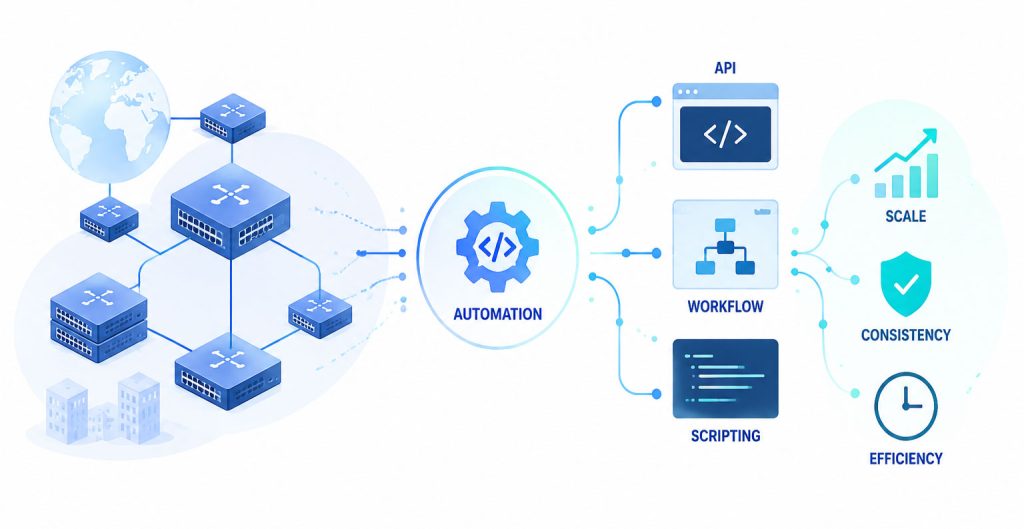
The reason is simple: enterprise networks have become too large and dynamic for every change to happen manually.
Imagine managing a company with hundreds of switches across multiple locations. A manual configuration approach might work when the environment is small. But as the network grows, manual processes become slower and introduce more opportunities for human error.
Automation does not replace networking knowledge. It amplifies it.
A strong automation engineer still needs to understand routing, switching, security, and troubleshooting. The difference is that they can apply those skills at a larger scale.
This is why ENCOR includes programmability. Cisco is recognizing that future network engineers are not only device operators. They are infrastructure professionals who understand how networks connect with software systems.
The transition can feel uncomfortable because it requires learning outside traditional networking. Many engineers who are excellent at troubleshooting CLI problems initially struggle with APIs or programming concepts. The solution is not to become a full-time software developer. The goal is to understand enough automation principles to work effectively in modern infrastructure environments.
Why Following A Study Plan Is Not Enough For ENCOR
A common preparation mistake is treating ENCOR like a checklist.
Candidates download the exam topics, find video courses, collect PDFs, and start checking boxes. The problem is that completing resources does not always create understanding.
ENCOR rewards relationships between concepts.
A candidate may understand BGP, wireless, SD-WAN, and security separately. But can they explain how these technologies interact in an enterprise design?
That is the difference between memorizing information and developing engineering judgment.
A better preparation approach focuses on questions like:
Why would an organization choose this technology?
What problem does this architecture solve?
What happens when this component fails?
How does this feature affect security or operations?
These questions create deeper understanding.
Another common issue is avoiding difficult areas. Some learners spend most of their time studying familiar topics because they feel productive. They configure routing labs repeatedly but avoid automation because it feels unfamiliar.
That approach creates an incomplete skill profile.
The uncomfortable areas are often where the biggest improvements happen.
Hands-on practice is also essential. Reading about technologies creates familiarity, but operating them creates confidence. Labs force you to deal with unexpected behavior, configuration mistakes, and troubleshooting scenarios.
Those experiences are closer to what enterprise engineers actually face.
The Preparation Strategy I Would Recommend In 2026
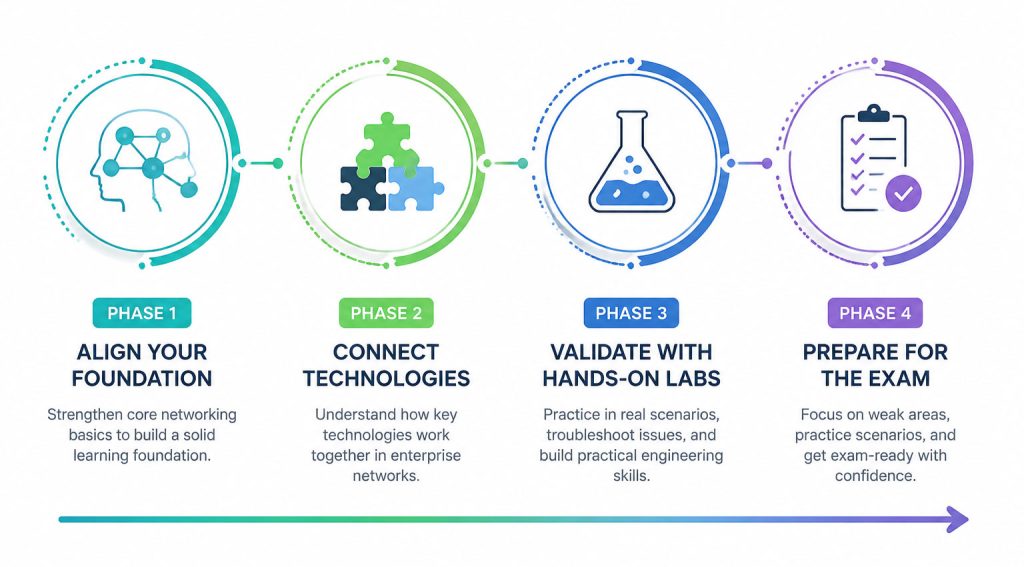
A realistic ENCOR preparation strategy should focus on building engineering ability, not just exam memory.
Phase 1 — Align Your Networking Foundation
Before diving into ENCOR topics, make sure your fundamentals are stable.
Routing behavior, switching concepts, IP addressing, network services, and troubleshooting methodology should feel comfortable. If these areas require constant reference, advanced topics will become unnecessarily difficult.
The goal is not perfection. The goal is having enough foundation that new concepts connect naturally.
Phase 2 — Connect Technologies Together
After reviewing individual technologies, start building relationships.
Study how routing interacts with security.
Understand how virtualization changes infrastructure design.
Learn why automation depends on accurate network information.
Enterprise networks are systems, not collections of isolated features.
Phase 3 — Validate Knowledge Through Labs
Hands-on practice should become a regular part of preparation.
Create scenarios rather than simply copying configurations.
For example, build a network, introduce a failure, and troubleshoot the result.
Try changing requirements and redesigning solutions.
This type of practice develops the decision-making ability ENCOR expects.
Phase 4 — Prepare For The Exam Environment
The final preparation stage should focus on exam readiness.
Review weak areas.
Practice interpreting technical scenarios.
Avoid spending the final weeks only memorizing facts.
The goal is to reach a point where questions feel like engineering situations rather than vocabulary tests.
Some candidates also use third-party practice resources such as Leads4Pass to evaluate readiness, although practice questions should complement — not replace — official study materials and hands-on experience.
The Difference Between Passing ENCOR And Becoming A Better Network Engineer
A certification result tells you whether you passed an exam. It does not automatically determine whether you can operate an enterprise network.
The real value of ENCOR comes from the knowledge developed during preparation.
A good ENCOR preparation process improves how engineers think.
Instead of asking:
“How do I configure this?”
They start asking:
“Why was this design selected?”
“What risks does this introduce?”
“How will this operate at scale?”
Those questions separate operational knowledge from engineering judgment.
ENCOR also creates a foundation for future paths, including CCNP Enterprise, CCIE Enterprise Infrastructure, cloud networking roles, and automation-focused infrastructure positions.
The certification itself is not the final destination. It is a structured way to develop skills that remain useful beyond the exam.
Is Cisco 350-401 ENCOR Worth It In 2026?
The value of ENCOR depends on your career direction.
For enterprise network engineers, infrastructure professionals, and people moving toward advanced networking roles, ENCOR remains highly relevant.
It provides a framework for understanding how modern networks are designed and operated.
It is especially useful for professionals working with:
- Enterprise routing and switching
- Wireless infrastructure
- Network security integration
- Cloud connectivity
- Network automation
However, ENCOR may not be the best starting point for someone without networking experience.
Beginners often benefit more from building foundational skills first through certifications such as CCNA 200-301 before attempting CCNP-level material.
A certification should match your current experience level.
The mistake is not choosing ENCOR. The mistake is starting it before you have enough foundation to understand the material.
The Real Value Of ENCOR Goes Beyond The Exam Result
The strongest reason to pursue Cisco 350-401 ENCOR is not the certificate itself.
The value comes from developing the ability to think like an enterprise engineer.
Modern networks are becoming more connected, automated, and software-driven. The engineers who succeed will not be the ones who only memorize commands. They will be the ones who understand architecture, solve problems, and adapt to new technologies.
ENCOR represents that transition.
It is the point where networking stops being about individual devices and becomes about designing reliable systems.
That mindset is what makes the certification valuable.
Conclusion
Cisco 350-401 ENCOR is challenging because it represents a different level of networking maturity. It asks engineers to move beyond configuration skills and develop broader technical judgment.
The best preparation strategy is not collecting more resources. It is building stronger connections between concepts, practicing real scenarios, and understanding why enterprise networks are designed the way they are.
For engineers willing to make that transition, ENCOR is more than an exam requirement. It is a practical step toward becoming the type of professional modern infrastructure teams need.
Frequently Asked Questions About Cisco 350-401 ENCOR
1. Is Cisco 350-401 ENCOR difficult for CCNA-certified professionals?
ENCOR is a significant step above CCNA because it requires deeper understanding of enterprise design, automation, security, and troubleshooting. CCNA knowledge provides the foundation, but candidates usually need additional hands-on experience and broader architectural thinking.
2. How long does it take to prepare for Cisco 350-401 ENCOR?
Preparation time depends on experience. Engineers with enterprise networking backgrounds may prepare in a few months, while those newer to advanced networking may need longer. Consistent practice is usually more effective than rushing through materials.
3. Should I learn Python before studying ENCOR?
Basic Python knowledge helps, but you do not need to become a software developer. Understanding how scripts, APIs, and automation tools interact with networks is the main goal.
4. Is ENCOR still valuable with cloud networking becoming more popular?
Yes. Cloud environments still depend on networking fundamentals. Enterprise cloud connectivity, security, automation, and hybrid infrastructure all require strong networking knowledge.
5. Can I pass ENCOR without lab practice?
It is possible, but not recommended. Labs create practical understanding and help connect theoretical concepts with real troubleshooting situations.

 exam
exam
Recent Comments