 Sharen C Soucie
Security teams are no longer deciding access based only on where a connection originates. Cisco 300-740 SCAZT reflects a deeper shift: access decisions now depend on identity, device trust, policy, and changing risk conditions.

The Security Challenge Cisco 300-740 Was Designed to Address
Cisco 300-740 SCAZT is often categorized as a secure cloud access exam, but that description does not fully explain its purpose. The technology environment behind this certification is changing because organizations no longer operate with a single, reliable security boundary.
The traditional model was easier to understand.
Users connected from corporate networks. Applications lived inside company-controlled environments. Security teams could make assumptions based on location.
Those assumptions became weaker as organizations adopted cloud services, remote work models, mobile devices, and distributed applications.
The challenge is no longer simply controlling network access.
The challenge is deciding whether access remains appropriate when multiple conditions change.
A user may have valid credentials but use an unmanaged device. A trusted employee may access a sensitive application from an unusual location. A partner may require temporary access to a limited resource.
The identity may be legitimate.
The access decision may still require additional evaluation.
That is the problem space Cisco 300-740 addresses.
The certification is valuable because it reflects a broader security transformation. Organizations are moving from static permission models toward systems that evaluate identity, context, and policy together.
Candidates who approach SCAZT as a collection of Cisco features often miss this connection. The stronger approach is understanding why enterprises need these technologies and what decisions they support.
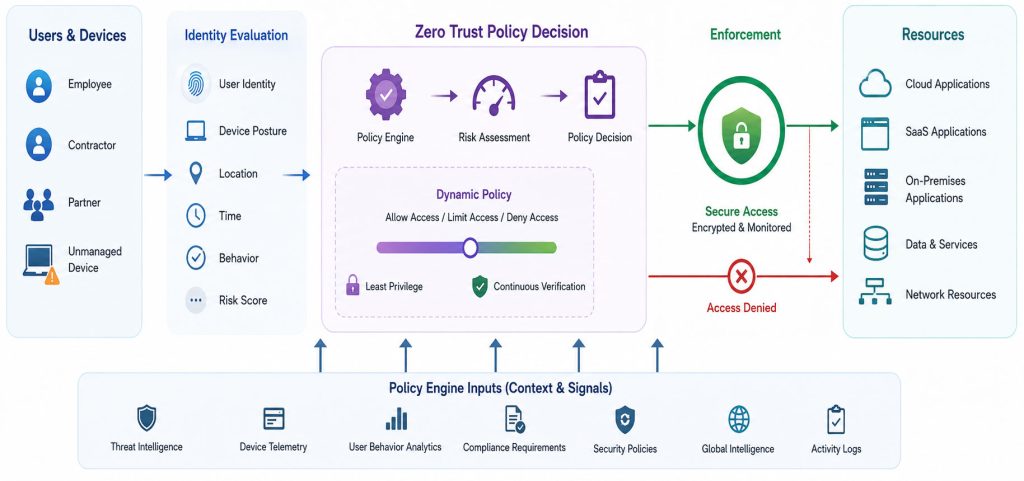
What Cisco 300-740 Really Evaluates Beyond the Exam Blueprint
The official Cisco 300-740 topics provide structure, but they do not explain the reasoning behind the exam objectives.
The important question is not:
“What technologies appear in SCAZT?”
The more useful question is:
“Why does an enterprise need these capabilities?”
Security professionals rarely solve problems by selecting a feature from a list. They evaluate situations where multiple requirements compete.
A business team wants productivity.
Security teams want risk reduction.
Users want simple access.
Compliance teams want evidence and control.
The engineer has to create a solution that satisfies these different needs without weakening security.
This is why Cisco 300-740 requires more than familiarity with terminology.
Consider authorization.
A basic explanation says authorization determines permissions.
That is correct but incomplete.
In enterprise environments, authorization represents a decision about acceptable risk.
A user might be allowed to access one application but denied access to another. A device might receive limited access because its security posture does not meet requirements. A temporary exception might exist because business operations require it.
The technical control exists because an organization has made a security decision.
A useful way to view the exam domains is:
| Area | Basic Technical Meaning | Practical Security Question |
|---|---|---|
| Authentication | Confirming identity | How confident are we about this identity? |
| Authorization | Granting access | What should this identity access? |
| Policy | Defining conditions | When should access change? |
| Posture | Evaluating device state | Can this endpoint be trusted? |
| Visibility | Monitoring activity | Does the decision remain appropriate? |
This perspective helps candidates avoid studying each domain separately.
Modern security controls work as a connected decision system.
Why Identity Became the Center of Modern Secure Access
Identity has become a central security concept because network location provides less reliable information than before.
However, identity itself does not automatically create trust.
Authentication proves something.
It does not answer every security question.
A successful login confirms that credentials or authentication factors are valid. It does not determine whether the user should access every resource under every condition.
This distinction is one of the most important concepts for Cisco 300-740 candidates.
A common preparation mistake is focusing heavily on authentication methods while spending less time understanding authorization logic.
Enterprise security teams care about both.
Imagine an employee accessing a sensitive financial system.
The employee authenticates successfully.
The account is legitimate.
The device, however, has outdated security controls and does not meet organizational requirements.
Should access remain unchanged?
This is where identity-driven security becomes more complex than traditional access models.
The decision depends on additional information.
Cisco Identity Services concepts are important because they demonstrate how organizations combine multiple signals:
- user identity
- device information
- security posture
- access requirements
- policy conditions
The goal is not creating more restrictions.
The goal is creating better decisions.
Experienced engineers sometimes disagree about how much context should influence access. Some argue that excessive policy complexity creates administrative challenges. Others believe that modern environments require more dynamic controls.
Both concerns are valid.
The answer is not maximum complexity.
The answer is designing policies that match organizational risk.
Cisco Identity Services and Policy: The Logic Behind Access Control
Many candidates initially study Cisco Identity Services Engine (ISE) as a product area. That approach can limit understanding.
The more valuable question is:
“How does an organization turn information into an access decision?”
A policy engine exists because security teams need consistency.
Without policy, access decisions depend too heavily on individual administrators and informal processes.
A well-designed policy considers several factors:
- Who is requesting access?
- What resource is being accessed?
- What device is being used?
- What security requirements apply?
- What level of risk is acceptable?
The difficulty is balancing security with operational reality.
A policy that blocks every uncertain situation may appear secure, but it can damage productivity.
A policy that allows everything may improve convenience while increasing exposure.
Security engineering exists between these extremes.
Cisco 300-740 candidates should understand that policy is not simply a technical rule.
It is a translation layer between business requirements and security enforcement.
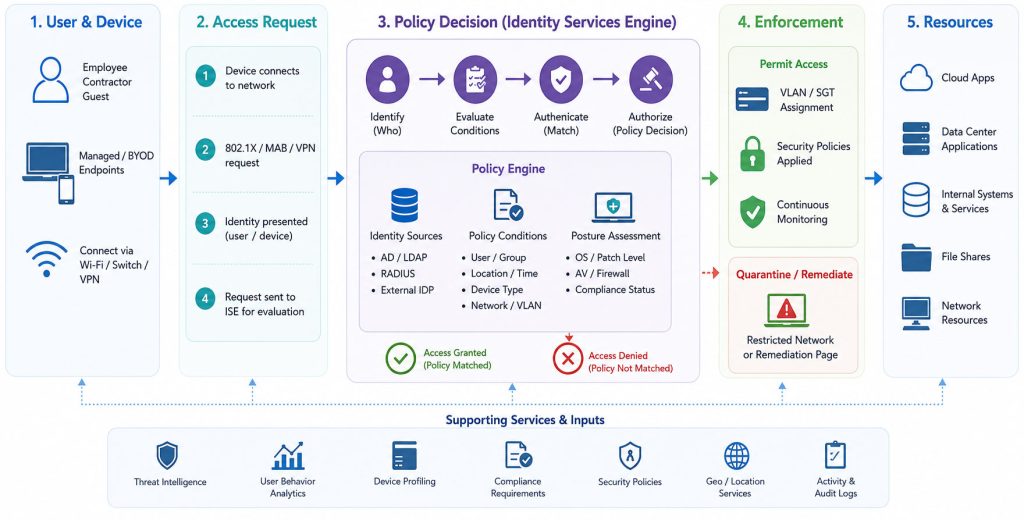
A practical example:
A contractor requires access to an internal application.
A simple approach asks:
“Does the contractor have valid credentials?”
A stronger security approach asks:
“What level of access is appropriate, from which device, for how long, and under what conditions?”
The second approach reflects the thinking Cisco 300-740 is designed to evaluate.
Zero Trust Thinking and the Reality Behind the Concept
Zero Trust is one of the most frequently discussed concepts in modern security, but it is also one of the most frequently simplified.
Some candidates treat Zero Trust as a product category. Others assume it is simply a replacement term for traditional security. Both interpretations miss the architectural reason behind the model.
The fundamental change is the removal of automatic trust.
Traditional security approaches often relied on the idea that network location provided meaningful confidence. A user inside the corporate environment was usually considered lower risk than someone outside.
That assumption became harder to maintain.
Cloud applications, remote employees, third-party access, and mobile devices created environments where the network boundary no longer represented the complete security picture.
Zero Trust does not mean trusting nothing.
It means trust must be justified by evidence.
NIST describes Zero Trust Architecture as an approach where access decisions consider identity, resources, policies, and context rather than relying only on network position. The important concept is continuous evaluation rather than permanent trust.
For Cisco 300-740 candidates, this distinction matters because the exam is not testing whether they recognize the phrase “Zero Trust.” The industry already knows the phrase.
The deeper question is whether candidates understand why organizations are moving toward this model.
A security team implementing Zero Trust is not simply adding another security layer.
It is changing the way access decisions are made.
A user receives access because multiple conditions support that decision. When those conditions change, the decision may need to change as well.
This creates an important engineering challenge.
More context improves security decisions, but additional context also increases complexity.
Experienced security professionals often debate how aggressively organizations should implement Zero Trust.
One approach focuses on broad transformation across identity, applications, devices, and networks.
Another approach starts with high-value resources and gradually expands controls.
Neither approach is automatically correct.
A global enterprise managing regulated information may require extensive identity controls. A smaller organization may achieve meaningful improvement through focused access policies.
The practical lesson for Cisco 300-740 preparation is that Zero Trust should be understood as a decision framework, not a checklist.
Where Candidates Commonly Misjudge Cisco 300-740 Preparation
Candidates preparing for Cisco security certifications usually fall into two groups.
Some are building security knowledge from the beginning.
Others already have professional experience in networking or infrastructure.
The second group often has an advantage, but that advantage can create unexpected gaps.
Network professionals are trained to think about communication paths.
That skill remains valuable.
However, secure access architecture requires a different starting point.
The question changes from:
“Can this traffic reach the destination?”
to:
“Should this identity receive access to this resource under these conditions?”
The two questions are connected, but they represent different security decisions.
One common mistake is focusing on Cisco technologies without understanding the security problem they solve.
Candidates may learn:
- Cisco ISE capabilities
- secure access components
- authentication methods
- policy terminology
but struggle to explain why those capabilities exist.
That creates knowledge without context.
Another mistake is treating exam preparation as a process of collecting information.
More documentation, videos, and notes do not automatically create better understanding.
The important measurement is whether each resource improves your ability to analyze a security situation.
A useful preparation question is:
“Could I explain this concept to an engineer who has never seen this technology before?”
If the answer is no, the understanding may still be too dependent on terminology.
Strong candidates build connections between concepts.
They understand:
- why identity matters
- how policy changes decisions
- why posture influences access
- where visibility fits into security operations
The goal is not knowing more isolated facts.
The goal is building a security decision model.
A More Effective Cisco 300-740 Study Strategy
The most efficient preparation approach follows the same order used by experienced security engineers.
Start with the security problem.
Then understand the architecture.
Then study the implementation details.
Many candidates reverse this process.
They begin with configuration examples and attempt to understand the purpose later.
That approach can work for basic technology familiarity, but it becomes inefficient when concepts overlap.
A practical study framework:
| Preparation Stage | Primary Focus | Key Question |
|---|---|---|
| Security foundation | Identity and access principles | Why is this control necessary? |
| Architecture understanding | Zero Trust and secure access models | How should decisions be made? |
| Cisco technology mapping | ISE and secure access solutions | Which technology supports this decision? |
| Practical scenarios | Troubleshooting and design thinking | Why did this access outcome occur? |
| Readiness evaluation | Knowledge validation | Can I explain the reasoning? |
This approach prevents a common problem: learning individual technologies without understanding relationships.
For example, understanding authentication alone does not explain secure access.
Understanding policy alone does not explain risk evaluation.
Understanding posture alone does not explain authorization.
The value comes from seeing how these pieces interact.
A strong Cisco 300-740 candidate should be able to describe a complete access decision process:
- A user requests access.
- Identity information is evaluated.
- Device and context information are considered.
- Policy determines the appropriate response.
- Enforcement occurs.
- Visibility confirms whether the decision remains valid.
This is closer to real enterprise security work than simply remembering technical definitions.
Building Labs That Develop Security Judgment
Hands-on experience is valuable for Cisco 300-740 preparation, but the type of lab matters.
A basic lab asks:
“Can you configure this feature?”
A stronger lab asks:
“Can you explain why this security decision happened?”
The second question develops professional capability.
Many candidates create successful configuration scenarios because success feels measurable.
The problem is that enterprise security is often defined by unexpected outcomes.
A user authenticates successfully but cannot access an application.
A device connects but receives restricted permissions.
A policy change affects an entire department.
These situations require analysis.
A useful Cisco 300-740 lab design should include changing conditions.
Example:
A remote employee needs access to a sensitive application.
The employee has valid credentials
The device, however, fails security posture requirements.
A weak lab focuses on restoring access.
A stronger lab investigates:
- What information influenced the decision?
- Which policy condition changed the result?
- Was the restriction appropriate?
- What alternative access method could reduce risk?
This type of scenario develops the same reasoning security engineers use in production environments.
Useful lab categories include:
| Scenario | Skill Developed |
|---|---|
| Authentication success but access denial | Policy troubleshooting |
| Different access levels for different users | Authorization design |
| Device compliance failure | Posture analysis |
| Changing business requirements | Policy adjustment |
| Security event affecting access | Continuous evaluation thinking |
Labs should not only confirm that configurations work.
They should help candidates understand why security systems behave the way they do.
Selecting Resources That Improve Real Understanding
A common preparation challenge is not finding resources.
It is selecting resources that create progress.
The certification market contains large amounts of content, but quantity does not guarantee quality.
The best resources help candidates connect technical details with security decisions.
A balanced resource approach usually includes:
| Resource | Best Purpose |
|---|---|
| Cisco official documentation | Accurate technical reference |
| Cisco Learning Network | Community discussion and exam insights |
| Cisco Live sessions | Architecture explanations |
| Cisco Press materials | Structured learning |
| Practice assessments | Identifying weak areas |
| Hands-on labs | Applying concepts |
Official Cisco resources should remain the foundation because they define supported technologies and certification expectations.
However, official documentation often explains what a technology does more clearly than why engineers make certain design choices.
That gap is where practical study methods become valuable.
After completing conceptual learning and hands-on practice, candidates may use assessment resources such as Leads4Pass Cisco 300-740 Practice Materials as one way to evaluate readiness. The useful purpose of practice material is identifying unclear areas and testing understanding, not replacing technical learning with answer recognition.
The strongest preparation usually combines multiple learning approaches.
Reading builds structure.
Labs build confidence.
Scenario analysis builds judgment.
Assessment reveals gaps.
Measuring Readiness Before Taking Cisco 300-740
Completing a study plan can create a false sense of progress.
A candidate finishes the official topics, watches training videos, reviews notes, and completes practice exercises. The remaining question is whether that activity has created usable understanding.
Cisco 300-740 readiness should not be measured only by how much material has been consumed.
A stronger measurement is whether you can analyze security decisions.
Consider these questions:
- Why is successful authentication not always enough for access?
- How does device posture influence authorization?
- Why would two users with identical identities receive different permissions?
- How does Zero Trust change traditional access assumptions?
- What business requirement is a security policy protecting?
Candidates who can answer these questions demonstrate architectural understanding.
Candidates who can only repeat definitions may still have gaps.
This distinction matters because real security environments rarely present problems exactly as they appear in training material.
A production issue may involve several possible causes:
A user cannot access an application.
Is the problem:
- authentication?
- authorization?
- policy logic?
- device compliance?
- application requirements?
- a change in security conditions?
The engineer must investigate relationships.
That ability is what separates certification knowledge from professional capability.
A practical readiness framework:
| Area | Strong Readiness Indicator | Warning Sign |
|---|---|---|
| Identity concepts | Can explain authentication and authorization differences | Treats both as the same process |
| Policy understanding | Can explain why access decisions change | Focuses only on rule syntax |
| Zero Trust knowledge | Understands the architectural purpose | Treats it as a product feature |
| Troubleshooting | Can analyze unexpected outcomes | Looks for only one possible cause |
| Enterprise thinking | Understands security and business tradeoffs | Expects one universal solution |
The final preparation stage should focus less on collecting more information and more on identifying uncertainty.
A candidate who knows where their understanding is weak can improve efficiently.
Cisco 300-740 Career Value and Professional Direction
Certification decisions are often made by comparing technical difficulty or popularity.
A more useful question is:
“Does this certification represent the type of security work I want to perform?”
Cisco 300-740 SCAZT aligns strongly with professionals working around secure access architecture, identity security, and Zero Trust implementation.
The knowledge applies to areas such as:
- identity and access management
- security architecture
- cloud security design
- enterprise access control
- secure remote access strategies
This makes the certification relevant for engineers who are moving from infrastructure-focused roles toward broader security responsibilities.
However, certification alone does not create security expertise.
The value comes from how the knowledge changes the way professionals approach problems.
A security engineer working on access architecture must understand more than technology.
They need to understand:
- business priorities
- user experience requirements
- operational limitations
- compliance expectations
- security risks
For example, a highly restrictive access policy may reduce exposure but create operational problems if employees cannot complete essential tasks.
A completely open access model may improve convenience but increase risk.
Security engineering exists in this balance.
Cisco 300-740 helps candidates develop a framework for thinking about these decisions.
It does not replace experience, but it can organize experience into a stronger professional model.
Cisco 300-740 Compared With Broader Security Skills
A common mistake is assuming one certification can represent complete security capability.
Modern cybersecurity is too broad for that.
Different roles require different strengths.
A firewall engineer may focus on traffic inspection and network enforcement.
A security analyst may focus on detection and investigation.
A security architect may focus on how multiple controls support organizational goals.
Cisco 300-740 sits closer to architecture and secure access decision-making.
A comparison:
| Skill Area | Primary Concern | Relationship to SCAZT |
|---|---|---|
| Network security | Controlling communication paths | Supports enforcement decisions |
| Identity security | Understanding users and access | Core SCAZT area |
| Cloud security | Protecting distributed resources | Connected to secure access |
| Threat response | Detecting malicious activity | Supports visibility and response |
| Security architecture | Designing complete models | Strong alignment |
This is why candidates should select certifications based on professional direction rather than simply choosing the most recognized option.
A certification becomes more valuable when it supports the problems you want to solve.
Suggested Study Roadmap for Cisco 300-740 Candidates
A practical roadmap should reflect how understanding develops.
Trying to learn every topic simultaneously usually creates unnecessary confusion.
A more effective progression:
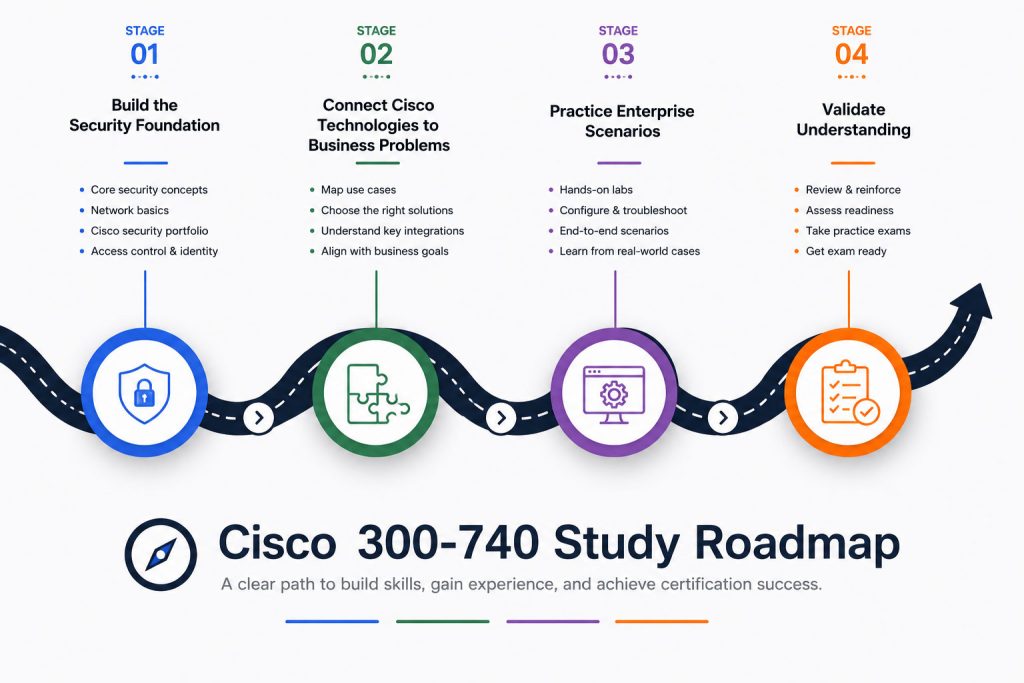
Stage 1: Build the Security Foundation
Focus on:
- identity concepts
- authentication methods
- authorization models
- policy-based access
- Zero Trust principles
The objective is understanding why secure access models exist.
Stage 2: Connect Cisco Technologies to Business Problems
Study how Cisco solutions support:
- access decisions
- identity information
- device evaluation
- policy enforcement
- visibility
Avoid treating technologies as isolated products.
Stage 3: Practice Enterprise Scenarios
Create situations where decisions are not obvious.
Examples:
- a compliant user versus a non-compliant device
- employee access versus contractor access
- normal behavior versus suspicious activity
The purpose is developing analysis skills.
Stage 4: Validate Understanding
Use:
- practice assessments
- troubleshooting exercises
- architecture discussions
The goal is discovering weak areas before the exam.
Final Perspective: Preparing for SCAZT as a Security Professional
Cisco 300-740 SCAZT represents an important change in how security professionals think about access.
The question is no longer simply whether someone can connect.
The question is whether access remains appropriate when identity, device condition, resource sensitivity, and risk factors are considered together.
That shift explains why candidates who approach the certification only through technology lists often struggle. Secure access is not one feature or one platform. It is a decision process supported by multiple security controls.
The strongest preparation approach is built around understanding relationships.
Identity provides information.
Policy creates decisions.
Authorization applies those decisions.
Visibility confirms whether those decisions remain appropriate.
Technology will continue changing.
Security platforms will evolve.
The professionals who remain effective are those who understand the reasoning behind security architecture.
Cisco 300-740 is valuable because it encourages that way of thinking.

 exam
exam
Recent Comments