 exam
exam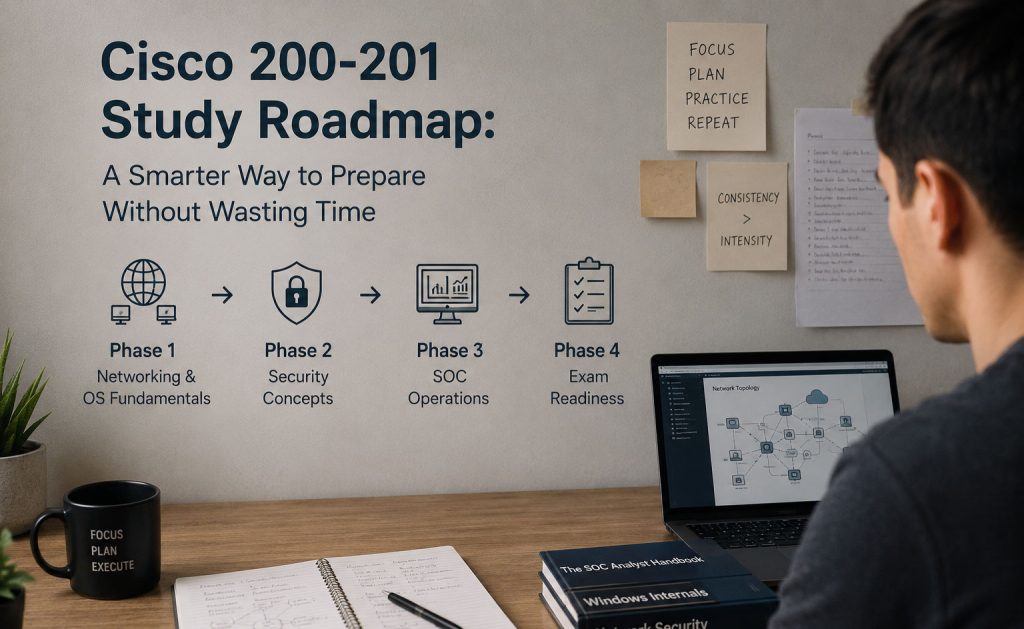
Many Cisco 200-201 CCNACBR candidates don’t fail because the exam is “too hard.” They struggle because their preparation starts in chaos. One week it’s YouTube playlists, the next week it’s PDF exam questions, and somewhere in between they try to memorize random SIEM alerts without understanding what they represent.
I’ve seen this pattern repeat for years while training junior SOC analysts and CCNA-level engineers moving into cybersecurity. The frustration usually sounds the same: “I studied everything, but nothing feels connected.“
That feeling is the real problem—not the exam itself.
The roadmap you’re about to read isn’t about adding more resources. It’s about removing friction. Because once you understand how SOC analysts actually think, Cisco 200-201 CCNACBR stops being a memory test and becomes a logical workflow.
Why Random Study Plans Waste Time
Most candidates unknowingly build their preparation backwards. Instead of learning in layers, they jump straight into exam objectives.
And that’s where things break.
Watching disconnected video playlists
Video playlists feel productive because you’re constantly “learning.” But without structure, your brain treats each topic as isolated noise. You might understand malware basics in one video and SIEM alerts in another, but you never connect how they interact during an actual incident.
That disconnect becomes obvious during practice questions where scenarios require multi-step reasoning.
Collecting too many PDF guides
There’s a quiet trap in certification prep: resource hoarding. Candidates download five or six “ultimate guides,” thinking coverage equals competence. In reality, switching between documents slows cognitive retention.
You stop learning and start comparing explanations instead of building understanding.
Ignoring hands-on SOC labs
This is the biggest failure point.
Reading about logs is not the same as reading logs. Watching packet analysis is not the same as doing it. SOC work is pattern recognition under uncertainty, and that skill only develops through repetition in real environments.
If you’ve ever felt confident after reading but lost during practice questions, this is likely why.
For a real-world perspective on this issue, there’s an insightful breakdown of candidate struggles here:
https://www.vcecert.com/cisco-200-201-ccnacbr-2026-real-pain-points-candidates-face-an-interview-with-soc-analyst-chester-j-hayden/
Build the Right Foundation Before Studying Cisco 200-201
This is where most people underestimate the exam. They think it’s “security-focused,” but the truth is simpler: it’s a networking exam wearing a cybersecurity coat.
If your foundation is weak, every topic feels harder than it should.
Networking fundamentals
You don’t need to be a CCIE. But you should understand how traffic flows. If someone mentions “east-west traffic,” your brain should immediately visualize internal network movement, not a buzzword.
OS and Linux basics
SOC analysts live in command lines more than dashboards. Even basic Linux navigation—file inspection, process checking, log reading—removes 50% of beginner confusion later.
TCP/IP, DNS, and HTTP essentials
If these protocols feel abstract, everything else becomes guesswork. DNS especially is underrated; many real-world incidents begin with DNS anomalies, not malware binaries.
A simple way to visualize this foundation is to draw a dependency map:
Networking → Protocols → Logs → Alerts → Incidents
Once you see this chain clearly, Cisco 200-201 CCNACBR stops feeling fragmented.
Learn Like a SOC Analyst Instead of an Exam Candidate
Here’s a shift I wish every candidate understood earlier:
SOC analysts don’t start with answers. They start with signals.
Incident lifecycle thinking
Every alert follows a story:
Detection → Validation → Containment → Investigation → Reporting
If you can’t place a question inside that lifecycle, it becomes guesswork instead of analysis.
Logs, SIEM, and alert correlation
Logs are not “data.” They are behavior traces.
A failed login is not just an event—it’s a potential reconnaissance attempt, or a misconfigured service, or a brute-force attack. Context changes meaning.
Tools like Splunk and Security Onion make more sense when you stop reading them as dashboards and start reading them as narratives.
For structured learning alignment, Cisco’s official learning platform is a strong reference point:https://www.cisco.com/site/us/en/services/professional/index.html
And MITRE ATT&CK is essential for understanding attacker behavior patterns:
https://attack.mitre.org/
A Practical Four-Phase Study Roadmap
This is where preparation becomes structured instead of reactive.
| Phase | Focus | What You’re Building |
|---|---|---|
| Phase 1 | Networking & OS fundamentals | Technical fluency |
| Phase 2 | Security concepts | Analytical vocabulary |
| Phase 3 | SOC operations | Real-world workflow thinking |
| Phase 4 | Exam readiness | Pattern recognition under pressure |
Why sequencing matters more than content volume
Most candidates think progress equals “more topics covered.” But in SOC work, sequencing is everything.
If you learn SIEM before understanding logs, you memorize screens instead of interpreting signals. If you study threats before understanding networks, you memorize attack names instead of attack behavior.
A structured sequence reduces mental load dramatically.
Hands-on Practice That Actually Improves Your Skills
Reading builds familiarity. Labs build intuition.
SOC tools and lab environments overview
Platforms worth your time include:
- Cisco U – structured Cisco learning paths
- https://u.cisco.com/paths
- Wireshark – packet-level visibility into real traffic
- https://www.wireshark.org/
- Splunk Free – log correlation practice
- https://www.splunk.com/
- Security Onion – full SOC simulation environment
- https://securityonion.net/
- TryHackMe – guided blue team scenarios
- https://tryhackme.com/
- Blue Team Labs Online – realistic incident simulations
- https://blueteamlabs.online/
A small insight from teaching labs: candidates who spend even 30 minutes a day in Wireshark outperform those who only read theory after two weeks.
Not because they are smarter—but because they’ve trained pattern recognition.
How to Know You’re Ready for Cisco 200-201
Readiness isn’t about mock scores. It’s about behavior.
You’re getting close when:
You can read logs without translating every line mentally.
You can describe an attack sequence without memorizing definitions.
You can open a packet capture and identify normal vs abnormal traffic flow.
You stop asking “what is this tool?” and start asking “what is this telling me?”
There’s a subtle shift here. Beginners try to recognize terms. Analysts try to understand meaning.
That shift matters more than any practice test score.
For additional practice insights and exam realism exposure, some candidates use structured questions like:
https://www.leads4pass.com/200-201.html
Not as a shortcut—but as a way to identify blind spots after hands-on work.
Building an Efficient Weekly Study Schedule
A realistic schedule beats an aggressive one you can’t maintain.
A balanced weekly structure might look like this:
3 days – Concept learning (reading + notes)
2 days – Lab practice (Wireshark, SIEM, scenarios)
1 day – Review and reflection
1 day – Practice questions + weak areas
The key is not intensity. It’s rhythm.
A simple visualization that helps candidates stay consistent is a weekly loop diagram:
Study → Practice → Review → Adjust → Repeat
One mistake I often see is overloading weekends with 8-hour sessions. It feels productive but leads to burnout. SOC skills grow better in smaller, repeated exposure cycles.
If you want to visualize progress, draw your own timeline:
- Week 1–2: Networking clarity
- Week 3–4: Security concepts
- Week 5–6: SOC simulation
- Week 7+: Mixed scenario practice
Over time, patterns start replacing memorization.
The candidates who eventually become strong SOC analysts rarely remember every detail from their certification journey. What stays with them is something quieter—the habit of questioning what they see before reacting to it.
That habit doesn’t come from reading more. It comes from slowing down long enough to understand why something matters before deciding what it is.
And once that way of thinking becomes natural, Cisco 200-201 CCNACBR stops being a milestone and starts feeling like an early checkpoint in a much longer professional mindset shift.


 Kyle Bray
Recent Comments