 exam
exam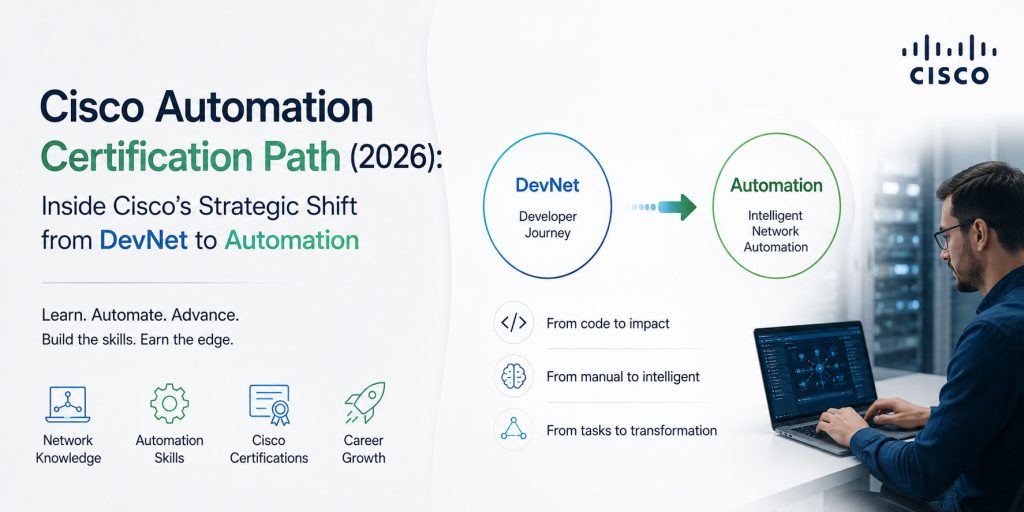
Cisco didn’t just rename DevNet to Automation—it quietly redefined what it means to be a network engineer. Behind the new certification codes like 200-901 CCNAAUTO and 350-901 AUTOCOR, there is a deeper repositioning tied to AI-driven infrastructure, enterprise cloud adoption, and the shrinking boundary between networking and software engineering.
Please note: I have cited remarks made by Cisco Live speakers without obtaining authorization to use their names; therefore, I have simply presented their views directly in the article.
Why Cisco Rebuilt DevNet into Automation (and What They’re Not Saying Out Loud)
When Cisco first introduced DevNet, it felt like a parallel track for “network engineers who code.” But over time, something shifted: enterprises stopped treating automation as optional. Internal Cisco learning materials and Cisco Live sessions over the last few years repeatedly emphasized a recurring theme—networks are becoming software systems, not configured devices.
That sounds simple until you look at enterprise reality.
A senior engineer from a Cisco Live Asia session once described it indirectly: “We no longer deploy networks. We deploy systems that generate networks.”
That mindset is exactly why DevNet could not remain a side track.
What Cisco is actually responding to

Cisco’s certification restructuring aligns tightly with three enterprise trends:
- Catalyst Center (DNA Center evolution) becoming a centralized automation layer
- Meraki cloud-managed networks reducing CLI dependency
- AI-assisted operations (AIOps) embedded in Cisco’s enterprise portfolio
- Increased adoption of Terraform, Ansible, and API-first operations
The certifications were rebranded because the job role itself changed.
PS.: Cisco didn’t rename DevNet because of marketing. It renamed it because “developer + network engineer” stopped being two separate identities in enterprise architecture teams.
The Automation Certification Ladder (Not as Linear as It Looks)
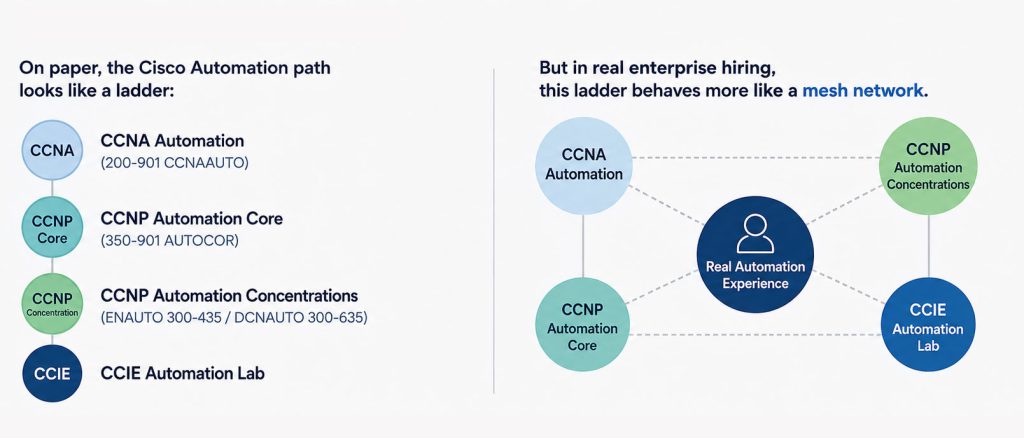
On paper, the Cisco Automation path looks like a ladder:
- CCNA Automation (200-901 CCNAAUTO)
- CCNP Automation Core (350-901 AUTOCOR)
- CCNP Automation Concentrations (ENAUTO 300-435 / DCNAUTO 300-635)
- CCIE Automation Lab
But in real enterprise hiring, this ladder behaves more like a mesh network.
Hiring managers often skip certifications entirely if candidates demonstrate real automation system experience.
CCNA Automation (200-901 CCNAAUTO): A Misunderstood Filter, Not a Beginner Exam
Most engineers assume 200-901 CCNAAUTO is just “CCNA with Python added,” That interpretation misses its purpose.
Cisco Learning Network discussions reveal a consistent pattern: candidates struggle not because of difficulty, but because of mindset mismatch.
The exam quietly tests:
- API awareness (REST/RESTCONF/NETCONF)
- Data formats (JSON, YAML)
- Basic Python logic applied to infrastructure
- Understanding of Cisco platforms like Catalyst Center and Meraki APIs
But the deeper intent is different.
Real scenario: enterprise onboarding
A mid-sized enterprise with ~500 branch switches begins migrating to Catalyst Center automation. The network team discovers something unexpected: engineers who are strong in CLI struggle more than junior engineers comfortable with APIs.
Why?
Because CLI experience creates device-centric thinking. Automation requires system-centric thinking.
Ps.: CCNA Automation is less about skill validation and more about “deprogramming CLI dependency.”
Why it matters
Hiring managers rarely expect CCNA Automation holders to be experts. Instead, they look for adaptability signals. If a candidate cannot mentally shift from CLI to API workflows, they are filtered out early in DevNet-style roles.
CCNP Automation Core (350-901 AUTOCOR): The Real Architectural Exam
If CCNA Automation is a filter, 350-901 AUTOCOR is a philosophy test disguised as an exam.
Cisco documentation describes it as “network automation system design,” but the real challenge lies in abstraction.
It evaluates:
- Automation architecture design
- API integration patterns
- Data modeling in network systems
- AI-driven network operations concepts
- Lifecycle automation thinking
Cisco Live speakers have repeatedly hinted that AUTOCOR is aligned with “intent-based networking evolution,” meaning engineers are tested on outcomes rather than steps.
Real scenario: migrating 800 devices
An enterprise network team managing 800 switches wants to migrate from manual configuration to Ansible-based automation integrated with Catalyst Center.
They quickly discover:
- Scripts alone do not scale
- API rate limits become operational constraints
- Data consistency becomes a bigger issue than configuration itself
- “Automation failures” often come from design flaws, not code errors
AUTOCOR indirectly tests whether engineers understand these systemic failures.
PS.: AUTOCOR is not about automation tools—it is about understanding why automation fails at scale.
Why it matters
Hiring managers in large enterprises increasingly use AUTOCOR-level thinking as a proxy for “can this engineer design systems that survive operational complexity?”
CCNP Automation Specializations: ENAUTO (300-435) vs DCNAUTO (300-635)
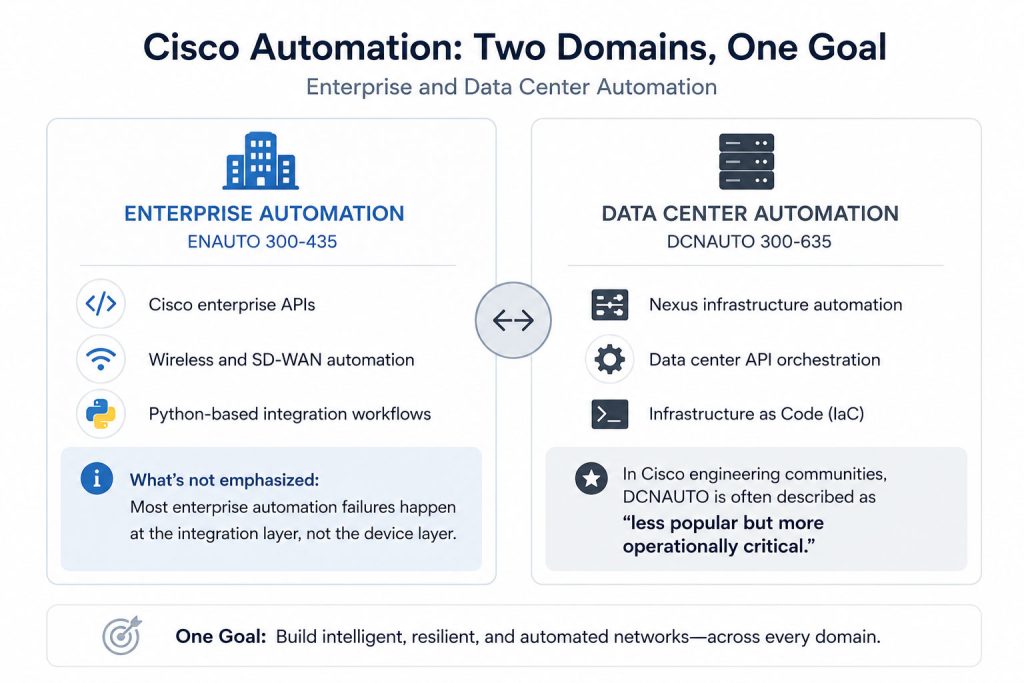
At this stage, Cisco splits automation into enterprise and data center domains.
ENAUTO 300-435: Enterprise Automation Reality
ENAUTO focuses on:
- Cisco enterprise APIs
- Wireless and SD-WAN automation
- Python-based integration workflows
But here is what Cisco does not explicitly emphasize:
Most enterprise automation failures happen at the integration layer, not the device layer.
DCNAUTO 300-635: Where Real Complexity Lives
DCNAUTO focuses on:
- Nexus infrastructure automation
- Data center API orchestration
- Infrastructure as Code (IaC)
In Cisco engineering communities, DCNAUTO is often described as “less popular but more operationally critical.”
Scenario Example: hybrid cloud migration
A financial enterprise migrating workloads between on-prem Nexus data centers and cloud environments realizes something unexpected:
Automation complexity is not linear—it increases exponentially with hybrid environments.
ENAUTO engineers handle orchestration logic, but DCNAUTO engineers handle stability under scale pressure.
PS.: Enterprise automation is visible; data center automation is where operational truth actually lives.
CCIE Automation: The Lab That Tests Engineering Reality, Not Knowledge
The CCIE Automation Lab is not an extension of CCNP—it is a different category of thinking.
Cisco describes it as “end-to-end automation lifecycle validation,” but candidates often misinterpret it as coding-heavy.
It is not.
It tests:
- System resilience design
- Multi-domain automation orchestration
- Failure recovery logic
- Real-time troubleshooting of automation pipelines
For example: broken automation pipeline
A simulated enterprise automation pipeline fails during deployment. The issue is not code—it is dependency timing between API calls across systems.
Most candidates fail because they debug symptoms instead of system behavior.
PS.: CCIE Automation is not about writing automation—it is about diagnosing automation under failure conditions.
DevNet vs Automation: The Hidden Strategic Shift
Cisco’s transition is not just naming—it reflects product alignment.
| Area | DevNet Era | Automation Era |
|---|---|---|
| Core idea | Developer tooling | System orchestration |
| Focus | APIs & SDKs | End-to-end infrastructure behavior |
| Alignment | Dev tools ecosystem | Catalyst Center, Meraki, AIOps |
| Hiring signal | Coding familiarity | System thinking ability |
What changed quietly is Cisco’s product strategy:
- Catalyst Center became central nervous system
- Meraki expanded cloud control adoption
- AI-assisted operations became embedded
DevNet trained engineers to use tools. Automation trains engineers to design systems that choose tools automatically.
Skills That Actually Matter (And Why Certifications Mislead Many Engineers)
Across Cisco Learning Network discussions and enterprise hiring patterns, a consistent gap appears:
Engineers overvalue certification and undervalue system understanding.
What actually matters:
- API reasoning (not memorization)
- Data flow understanding
- Failure mode analysis
- Infrastructure abstraction thinking
- Python used as orchestration glue, not software engineering
Most automation failures in production are not coding failures—they are architecture assumptions that never held under scale.
AIOps and Cisco Automation: The Direction Most Engineers Are Underestimating
Cisco is gradually integrating AI into network operations:
- anomaly detection in telemetry streams
- automated remediation suggestions
- predictive scaling in SD-WAN environments
But there is a subtle shift:
AI is not replacing automation engineers—it is changing what they debug.
Instead of configuring systems, engineers increasingly validate AI decisions.
PS.: The next generation of network engineers will spend more time questioning automation outputs than writing automation scripts.
Hiring Reality: What Companies Actually Look For
Despite Cisco’s structured certification path, hiring does not follow it strictly.
Recruiters typically prioritize:
- hands-on automation experience (Ansible/Terraform)
- cloud networking exposure
- incident troubleshooting history
- API integration experience
Certifications act as filters, not qualifications.
ps.In enterprise hiring, CCNP Automation is often treated as “signal of exposure,” not “proof of competence.”
Common Engineering Mistakes in Automation Adoption
From enterprise case discussions and Cisco partner reports:
- Treating automation as scripting instead of system design
- Ignoring data consistency across APIs
- Over-relying on tools like Ansible without understanding backend APIs
- Assuming cloud equals automation maturity
The biggest automation failure pattern is “tool-first thinking instead of system-first thinking.”
Skills Matrix for Cisco Automation Engineers
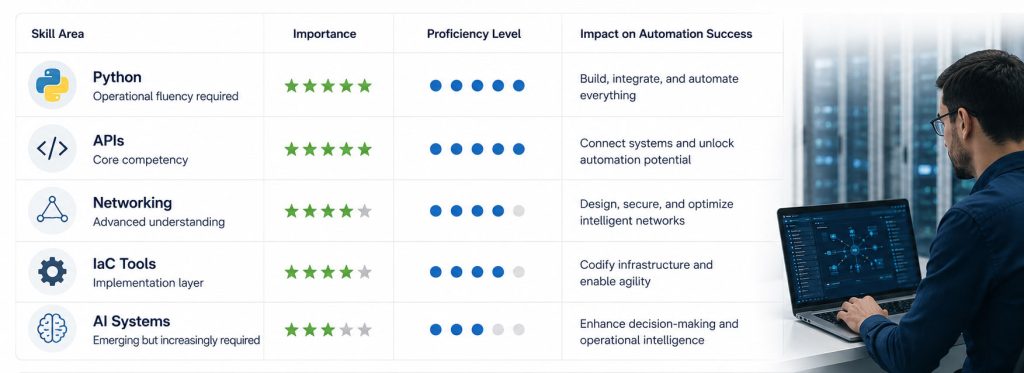
- Python: operational fluency required
- APIs: core competency
- Networking: advanced understanding
- IaC tools: implementation layer
- AI systems: emerging but increasingly required
Career Paths Emerging from Cisco Automation
- Network Automation Engineer
- NetDevOps Architect
- Infrastructure Platform Engineer
- Cloud Networking Specialist
- SRE (with networking background)
But one trend is becoming clear:
Roles are converging.
The distinction between network engineer and software engineer is dissolving faster in infrastructure teams than anywhere else in IT.
Where Cisco Automation Is Heading Next
Cisco’s roadmap, based on public announcements and product evolution patterns, suggests three directions:
- deeper AI integration into Catalyst Center
- expanded API-first networking across Meraki and enterprise platforms
- tighter alignment between cloud networking and on-prem automation systems
But the real shift is conceptual:
Networking is becoming behavior-driven rather than configuration-driven.
The future network is less something engineers configure and more something they define constraints for.
I spent a considerable amount of time gathering and organizing information to write this article.
In closing, I would like to say:
Cisco Automation is not a certification evolution—it is a reflection of how infrastructure itself is being redefined.
The most important shift is not technical but cognitive: engineers are moving from configuring systems to designing systems that configure themselves under constraints.
And as AI begins to sit inside the operational loop—suggesting changes, detecting anomalies, even initiating remediation—the role of the engineer shifts again.
Not toward less responsibility, but toward a different kind of responsibility: understanding intent, validating machine decisions, and ensuring that automation behaves correctly when reality refuses to match design assumptions.
The next era of networking will not be defined by who knows the most commands—but by who understands the consequences of systems that no longer wait for commands at all.


Recent Comments