 exam
exam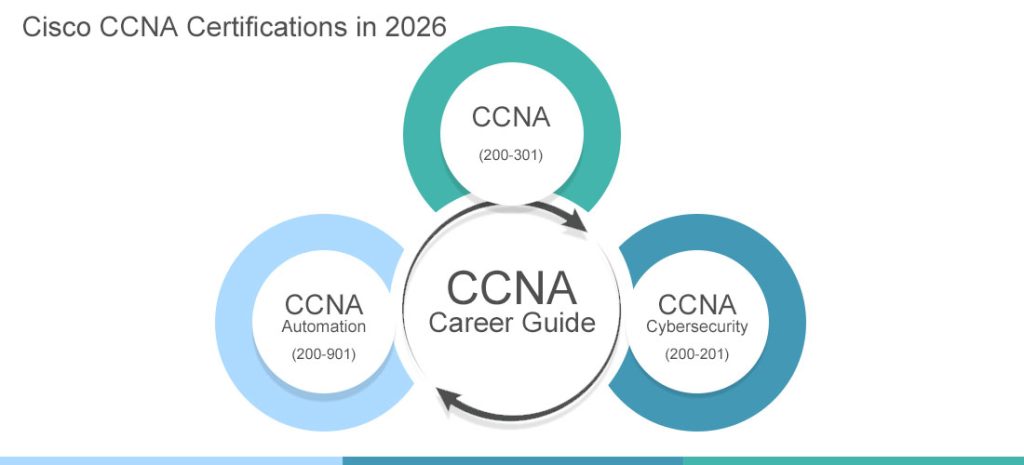
Most CCNA discussions still start from the wrong assumption: that there is a single certification path leading to “a networking job.” That model quietly stopped being accurate as enterprise infrastructure stopped behaving like isolated networks. What replaced it is more fragmented—networking now sits inside cloud platforms, automation pipelines, and security-driven architectures.
So the real question in 2026 is not whether CCNA is valuable. It is how it fits into an ecosystem where entry-level engineers are expected to understand systems that extend far beyond routing and switching. The answer depends less on exam content and more on the direction of your career identity.
In practice, CCNA is increasingly used as a “sorting signal” rather than a definition of competence. It tells employers you can think in network logic—but not yet whether you can operate in hybrid environments where network behavior is shaped by identity systems, APIs, and policy engines.
CCNA in 2026 Is No Longer a Single Lane
Cisco’s certification structure has shifted from consolidation to specialization at the entry level. That alone changes how hiring teams interpret “CCNA.”
The traditional CCNA 200-301 still exists as the foundation, but it is no longer the only relevant entry point. Alongside it, Cisco now positions role-aligned tracks like CCNA Automation and CCNA Cybersecurity, which reflect how job roles are actually distributed in modern infrastructure teams.
What matters here is not the naming. It is the implicit message: Cisco is acknowledging that “networking” is no longer a single discipline. It is a set of overlapping responsibilities distributed across infrastructure, software, and security domains.
A pattern that consistently appears in enterprise environments is that junior engineers are no longer hired purely to configure devices. They are hired to participate in workflows—incident response, automation pipelines, and cloud-integrated operations.
That shift changes what CCNA represents in hiring decisions. It is no longer a finish line. It is a classification of direction.
The practical reality is simple: teams don’t ask “Do you know networking?” as much as “Where can we safely place you in our operational stack without slowing everyone else down?”
The Foundational CCNA Still Matters, But Not for the Reasons People Think
CCNA 200-301 remains the most widely recognized baseline certification, but its real value in 2026 is less about command knowledge and more about cognitive structure.
Employers increasingly treat it as evidence that someone understands how systems interact under constraints—how routing decisions propagate, how segmentation affects application behavior, and how small misconfigurations can cascade across hybrid environments.
A recurring hiring observation is that CCNA-certified candidates who struggle are not failing because they lack knowledge of commands. They struggle because they learned networking as a static system instead of a dynamic one.
Troubleshooting expectations have also shifted. It is no longer enough to identify where something breaks. Engineers are expected to reason about why multiple systems failed together.
In real operational environments, a network issue is rarely “just network.” It is often a symptom of something upstream: identity misalignment, cloud routing policy, or automated configuration drift.
The real hidden filter is whether a candidate naturally asks what changed across the system instead of focusing on a single device.
That mindset often matters more than any individual exam objective.
CCNA Automation: Where Networking Stops Being Manual Work
Cisco’s automation track reflects a structural change in how infrastructure is operated.
The CCNA Automation (200-901) certification signals familiarity with APIs, scripting, and programmable infrastructure. Official exam structure includes topics such as Python fundamentals, REST APIs, and Cisco platform integration for automation workflows.
But the more important shift is operational rather than technical.
Automation is no longer a specialized layer of engineering—it is embedded in daily network operations. Configuration changes, validation checks, and even incident response steps are increasingly executed through APIs or automation pipelines.
A subtle but important reality in enterprise teams is that automation is not judged by coding ability alone. It is judged by whether changes can safely scale across systems without introducing hidden dependencies.
Engineers who treat automation as “script writing” often plateau. Engineers who treat it as “system control at scale” tend to move into design conversations earlier.
The real dividing line is not Python knowledge. It is whether you understand that every automated action becomes part of the production system’s behavior.
That shift changes responsibility, not just skillset.
CCNA Cybersecurity: Networking Inside Security Constraints
The CCNA Cybersecurity path reflects another reality: network decisions are now security decisions by default.
Routing, segmentation, and access control are increasingly evaluated through security outcomes first and performance second.
In enterprise environments, network engineers frequently interact with SOC teams during investigations. A blocked connection might represent policy enforcement, threat containment, or identity-based access restriction—not just a misconfiguration.
One of the less obvious shifts in modern infrastructure teams is that troubleshooting is no longer isolated. It is collaborative by default, especially between networking and security functions.
Engineers who understand both domains often become informal translators between SOC findings and network behavior. That role is rarely defined in job descriptions, but it becomes essential during incidents.
What changes everything here is responsibility: engineers are increasingly expected to explain not only why traffic flows, but why it should not.
That inversion fundamentally changes how network thinking is applied in production systems.
Why Cisco Split CCNA Into Multiple Directions
Cisco did not expand CCNA because the certification was insufficient. It expanded because job roles stopped fitting into a single entry-level identity.
Modern infrastructure environments operate across:
- Cloud networking systems
- API-driven configuration models
- Security-first architectures (zero trust, identity-aware policies)
- Automated monitoring and remediation pipelines
- AI-assisted operational tooling
The important shift is not technical breadth—it is role fragmentation.
A CCNA-level engineer is no longer expected to specialize immediately. Instead, they are expected to function inside a system where specialization happens gradually through exposure to real operational domains.
The underlying message is subtle but important: entry-level networking is no longer a standalone career track. It is a gateway into multiple infrastructure disciplines.
Adaptability is now interpreted less as willingness to learn and more as ability to operate in systems where boundaries between teams are unclear.
What Hiring Managers Actually Filter For
Certification still matters, but only as a baseline signal. It rarely determines hiring decisions on its own.
What differentiates candidates is how they think across systems.
Hiring teams tend to prioritize:
- Whether candidates can troubleshoot across network, cloud, and identity layers
- Whether they understand automation concepts beyond theory
- Whether they recognize security implications in infrastructure decisions
- Whether they can communicate across teams with different technical languages
- Whether they can function in partially automated environments
In practice, two CCNA candidates can look identical on paper but behave completely differently in production scenarios.
The distinction is rarely about knowledge depth. It is about whether they can follow causality across systems that are not explicitly connected in exam material.
A useful way hiring teams often evaluate this informally is by observing whether a candidate naturally looks for upstream causes or isolated fixes.
That difference becomes more important as environments grow more interconnected.
Automation Is No Longer Optional
A common misconception among beginners is that automation is an advanced topic reserved for specialized roles.
That assumption no longer matches reality.
Even entry-level infrastructure roles now interact with:
- API-driven configuration systems
- Basic scripting logic
- Infrastructure-as-code patterns
- Automated monitoring outputs
- Version-controlled operational workflows
Manual-only network operation is steadily shrinking, not because traditional skills are obsolete, but because scale has changed what “operation” means.
The real dividing line is not seniority. It is whether your work can be reliably reproduced and validated through systems without direct human intervention.
Engineers who combine networking fundamentals with automation literacy tend to transition faster into hybrid roles involving design, integration, or architecture.
Cybersecurity and Networking Are Converging Faster Than Job Titles Suggest
Firewall policies, segmentation rules, and identity-based access controls are now deeply integrated into network design.
As a result, network changes frequently trigger security validation workflows, and security findings often require network-level interpretation.
In many enterprise environments, the distinction between “network issue” and “security issue” is determined during investigation, not at the moment of failure.
This creates a practical reality: engineers who understand both domains reduce resolution time significantly because they can interpret signals from both perspectives.
The value is not specialization. It is translation between systems that operate under different assumptions.
That capability is becoming increasingly important in hybrid cloud environments where policy, identity, and connectivity intersect continuously.
CCNA as a Decision Point, Not a Destination
The most important reframing in 2026 is this: CCNA is no longer an endpoint. It is a branching mechanism.
The real decision is not whether to pursue it, but what direction it should unlock:
- Infrastructure engineering
- Automation and systems integration
- Security-oriented networking roles
Each direction shares the same foundation but diverges quickly in daily work.
A common mistake is treating CCNA preparation as a closed system. Candidates who do this often struggle when they encounter environments where networking is influenced by cloud platforms, automation pipelines, or identity systems.
Those who progress faster tend to treat CCNA as a lens for understanding systems rather than a fixed body of knowledge.
AI in Networking: Assistance, Not Replacement
AI-driven tools are already embedded in network operations through monitoring, anomaly detection, and configuration suggestions.
However, their role is not to replace engineers but to compress decision cycles.
The key limitation is that AI operates without full awareness of architectural intent. It can identify patterns but cannot reliably interpret whether a change aligns with system design constraints.
This creates a new skill requirement: engineers must be able to evaluate AI outputs against architectural understanding rather than treating them as authoritative.
The real differentiator is not who uses AI tools, but who can confidently override them when system context demands it.
That judgment becomes increasingly important as automation and AI become standard across infrastructure platforms.
Conclusion
Cisco’s CCNA ecosystem in 2026 reflects something larger than certification redesign. It reflects the fragmentation of networking into a broader infrastructure landscape shaped by cloud, security, automation, and AI.
The real shift is not that CCNA has changed. It is that the world around it has expanded faster than traditional role definitions.
The engineers who benefit most are not those who focus on passing exams efficiently, but those who use foundational knowledge to navigate multiple possible directions.
CCNA no longer defines a career path.
It defines a starting point for deciding what kind of systems engineer you want to become in an environment where every system is connected, and no discipline stands alone.


Recent Comments