I still remember the first time I seriously looked at the CCDE written exam outline. Not gonna lie — it felt intimidating. Not because of the technologies themselves, but because CCDE 400-007 doesn’t test what commands you know. It tests how you think.
If you’ve ever passed CCNP or even CCIE written exams and then hit a wall with CCDE, you’re not alone. Many solid engineers struggle here. The reason is simple: CCDE isn’t about “how to configure,” it’s about why a design makes sense in a business context.
In this article, I’ll walk you through the latest CCDE 400-007 exam, share real preparation advice from an engineer’s point of view, and provide free practice tests to help you benchmark your readiness — without the fluff or marketing hype.
What Is the CCDE 400-007 Written Exam?
A Quick Overview (As of December 2025)
The CCDE 400-007 is the written qualification exam required before attempting the CCDE practical. It’s not an entry-level exam by any stretch.
Here’s what you should know:
- Exam name: Designing Cisco Enterprise Networks (CCDE 400-007)
- Duration: 120 minutes
- Number of questions: ~90–110
- Question types:
- Single choice
- Multiple choice
- Scenario-based questions (some with diagrams)
- Passing score: Not published (Cisco-style scaling)
- Difficulty: Very high
By December 2025, the exam continues to emphasize design trade-offs, constraints, and justification, not feature memorization.
Why CCDE 400-007 Feels So Hard
It Punishes “Config-First” Thinking
If your instinct is to jump straight to protocols or vendors, CCDE will catch you.
The exam expects you to ask:
- What is the business goal?
- What constraints exist?
- What risks matter most?
- Why is one design better than another?
Many candidates fail not because they lack knowledge, but because they answer from an implementation mindset, not a design mindset.
Latest CCDE 400-007 Exam Blueprint (2025)
Cisco currently divides the exam into five major domains:
1. Business Strategy Design – 15%
- Translating business requirements into technical designs
- Cost, risk, and scalability considerations
- Stakeholder alignment
2. Control, Data, and Management Plane Design – 25%
- Separation of planes
- Resiliency and convergence strategies
- Control plane scalability
3. Network Design – 35%
- Enterprise, WAN, and data center design
- Routing and switching architecture
- High availability and failure domains
4. Service Design – 15%
- QoS
- Security services
- Multicast and service integration
5. 5.0 Security Design – 10%
- Segmentation
- Network access control
- Visibility
- Policy enforcement
- CIA triad
- Regulatory compliance (if provided the regulation)
Understanding how these domains interact is far more important than memorizing them.
How to Think Like a CCDE (This Matters More Than Study Time)
Focus on “Why,” Not “How”
A CCDE-style question almost never asks:
“How do you configure X?”
Instead, it asks:
“Which design best meets these competing requirements?”
When studying, force yourself to explain:
- Why not the other options?
- What trade-off is being accepted?
- Who benefits from this design?
Common Traps That Cause Candidates to Fail
1. Overengineering
Bigger isn’t always better. CCDE often rewards simpler, risk-aware designs.
2. Ignoring Business Constraints
Latency, budget, compliance, and operations matter just as much as technology.
3. Chasing ‘Perfect’ Designs
Sometimes the least bad option is the correct one.
Recommended Official and Trusted Study Resources
Cisco Official Resources
- CCDE exam blueprint (Cisco Learning Network)
- Cisco Validated Designs (CVDs)
- Cisco white papers
Books That Actually Help
- CCDE Study Guide (Cisco Press)
- Optimal Routing Design
- Internet Routing Architectures
Video & Lab-Based Learning
- INE CCDE Design Courses
- Advanced enterprise design workshops
These resources build design intuition, not just knowledge.
About CCDE 400-007 Exam Dumps — Let’s Be Real
I’ll be honest here.
Blindly memorizing low-quality dumps is a terrible idea. They won’t help you think like a designer, and outdated questions can actually hurt you.
That said, well-maintained, scenario-focused question banks can be useful — if you use them to analyze why an answer is correct.
Many candidates I know (myself included) used Leads4Pass CCDE 400-007 exam dumps (https://www.leads4pass.com/400-007.html) as a supplement, not a shortcut. The updates are timely, coverage is solid, and the pricing is reasonable.
Free CCDE 400-007 Online Practice Tests (Updated)
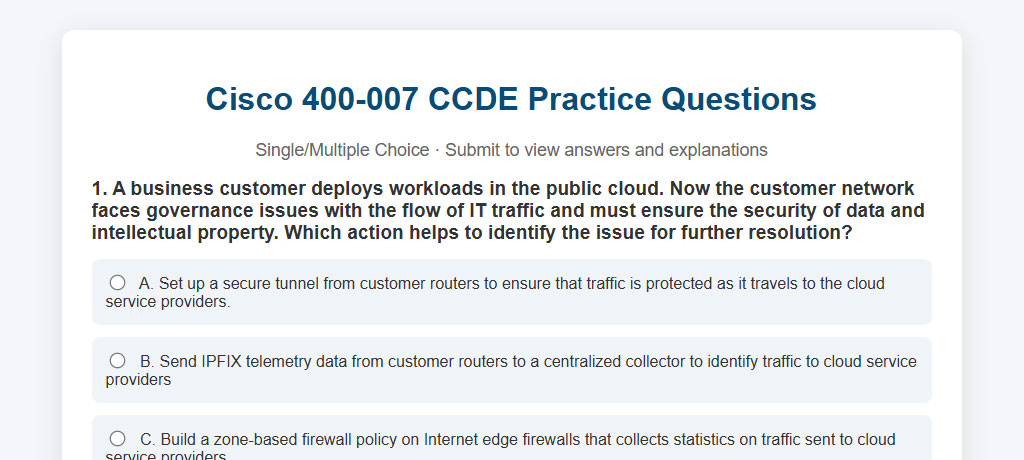
To help you check your current level, I’ve prepared 15 high-quality practice questions based on the latest exam topics.
These include:
- Single-choice questions
- Multiple-choice questions
- Scenario-based questions with diagrams
How It Works
- Answer questions directly below
- Submit to see instant answers and detailed explanations
- Works smoothly on both mobile and desktop
| Free Share | Update time |
| 15Q&As (Free) | Dec, 2025 |

exam
VCECERT is the largest community of Cisco free dumps, here has the latest and most complete Cisco (CCNA, CCNP, Channel Partner Program, Cisco Meraki Solutions Specialist, Express Specialization - SMB Track, Advanced Security Architecture Specialization...) dump Community.exam
- CCNP Enterprise , Cisco , Cisco 300-445 ENNA Exam , Cisco CCNP
- October 16, 2026
- 136 views
Free Cisco 300-445 ENNA Practice Questions for 2026
Preparing for the 2026 Cisco 300-445 ENNA exam requires more than recognizing networking terminology.
You need to interpret monitoring data, identify performance problems, and understand which assurance tools fit a particular environment. These free Cisco 300-445 ENNA practice questions cover the exam’s main objective areas, with explanations to help you identify knowledge gaps and decide what to review next.
A comprehensive review to identify and address any gaps is essential for gauging your true level of preparation. Download or practice online with these 2026 Cisco 300-445 exam dumps: https://www.leads4pass.com/300-445.html (168 questions in total)—with an actual exam appearance rate of over 99.5%.
What to Know About the Cisco 300-445 ENNA Exam
The Designing and Implementing Enterprise Network Assurance (300-445 ENNA) exam evaluates skills in enterprise network assurance design and implementation. Passing earns the Cisco Certified Specialist – Enterprise Network Assurance certification and can fulfill the concentration exam requirement for CCNP Enterprise.
» Read more about: Free Cisco 300-445 ENNA Practice Questions for 2026 »
- CCNP Service Provider Certification , Cisco , Cisco 300-540 Exam Prep
- October 9, 2026
- 225 views
Cisco 300-540 Exam Prep: What Actually Helps You Pass?
Preparing for the Cisco 300-540 SPCNI exam can become frustrating when hours of reading and practice produce little confidence about your actual readiness. The problem is often not a lack of study time, but a lack of useful feedback. You need to know which concepts you understand, where your reasoning breaks down, and whether you can apply what you have learned to unfamiliar technical scenarios. A better preparation process turns those uncertainties into specific decisions about what to study next.
Cisco describes the 300-540 SPCNI exam as a 90-minute assessment covering virtualized architecture, cloud interconnect, high availability, security, and service assurance and optimization. It also serves as a concentration exam option for the CCNP Service Provider certification.
These details define the scope but do not tell you how to prepare efficiently. Use Cisco 300-540 dumps (https://www.leads4pass.com/300-540.html) to enhance your experience, identify knowledge gaps, and develop the ability to articulate the technical decisions behind the answers.
» Read more about: Cisco 300-540 Exam Prep: What Actually Helps You Pass? »
Recent Comments